Commissioning AN ARTIST
A commission becomes a collaboration between artist and collector.
By Mark Holliway

Central Park has always held a special place in my heart. Its beauty, history, nostalgia, and romance make it unlike anywhere else. As a filmmaker, I have also been drawn to the way it appears on screen. When I had one space left on a wall in my home, I knew what belonged there: a painting of Central Park’s Gapstow Bridge.
For nearly two years, I looked for one. I found plenty of images of the bridge, but none captured what I envisioned. Then, during an ArtWalk in St. Petersburg’s Warehouse Arts District in September 2025, I wandered into Nancie Norman’s studio. I told her about my search. Her answer was simple: “I can do it for you.”
Until then, commissioning a painting had never crossed my mind.
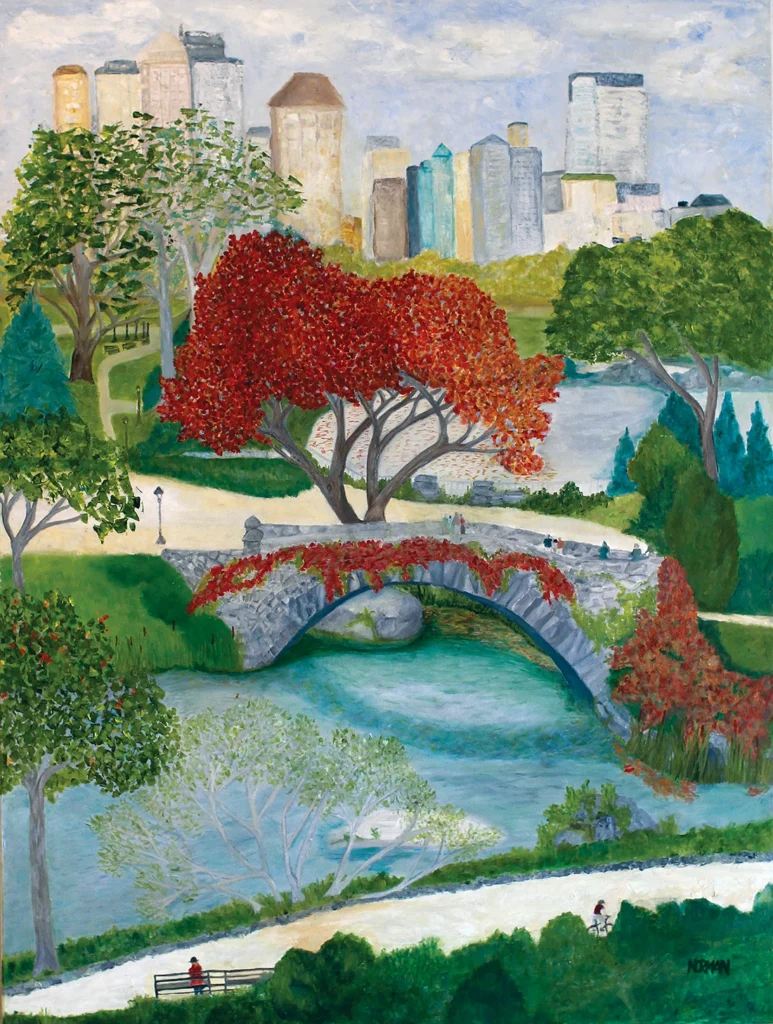
Over the next eleven months, the idea became a creative collaboration. I could tell Nancie why Gapstow Bridge mattered to me, but I could not have told her how to paint it. That called for her eye, her instincts, and the many decisions an artist makes as a work takes shape. I wanted to give her the freedom to interpret the scene, because the point of asking Nancie to create it was to see what she would bring to it.
During that time, Nancie attended an art workshop in Tuscany and later traveled to Central Park to experience the bridge firsthand. Before her visit, she had included a bicyclist in the painting. At the park, she learned that bicycles were not permitted on that pathway. She asked whether I wanted the cyclist removed.
My answer was an immediate no. The bicyclist was part of Nancie’s original vision of the park, and it belonged in the painting.
That small decision says a great deal about commissioning art. A collector may bring the subject, a memory, a room, or a feeling to the conversation. The artist brings a way of seeing. The most rewarding result comes when both have a voice and the artist has room to make something original.
Commissions can begin in many ways. Someone might want a portrait of a person or a pet, a painting of a meaningful place, or an abstract work inspired by particular colors and emotions. A conversation with the artist helps turn that starting point into a shared understanding. What matters most about the subject? Where will the work live? Is there a detail that must be included? And where can the artist’s imagination take the lead?
For anyone considering a commission, looking closely at an artist’s existing work is a good place to start. You are choosing more than someone who can reproduce an image. You are choosing the person whose style and perspective you want to bring into your home. From there, a clear discussion of the size, medium, price, schedule, and creative process gives both artist and collector a sound foundation.
St. Petersburg has an extraordinary community of artists whose studios offer a chance to have those conversations in person. A visit during an ArtWalk might introduce you to a work you love. It might also introduce you to the artist who can create the work you have been unable to find.
My Gapstow Bridge painting began with an empty space on a wall and a place I could not stop thinking about. It grew through Nancie’s talent and the freedom to let her make it her own. Now it carries both the scene I hoped for and the story of how it came to be. That is something I can enjoy for a lifetime and, one day, pass on. •