Home Blog Page 24

The Art of – Kirk Ke Wang

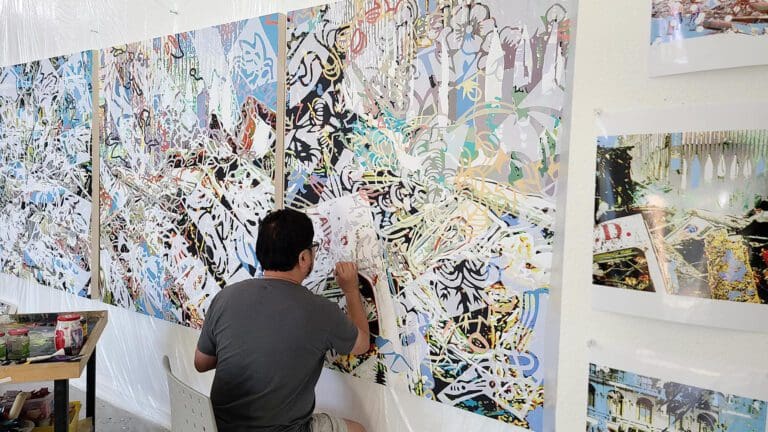
More and more often these days the Tampa Bay region can claim artists who are internationally esteemed. Kirk Ke Wang has established himself not only locally, but significantly throughout the world. His paintings have been exhibited at the Museum of Modern Art in New York, the National Museum of Art in Beijing, and the Dr. Sun Yet-Sen National Gallery of Taiwan in Taipei, among many others.

Born in Shanghai, China, Wang’s early life has played a crucial role in shaping his artistic sensibilities. His work is characterized by an intricate use of color, patterns, and symbolism. His unique multiculturalism is reflected in the blend of Eastern and Western sensibilities witnessed in everything he applies himself to. He is a successful painter, sculptor, photographer, mixed media artist, and educator. 

Wang lived briefly in a labor camp with his parents during the cultural revolution in China. At age 16 he attended the Nanjing Normal University acquiring a MFA and became an assistant professor of art all by the age of 20 years old. After winning a Bronze medal from the Cultural Ministry of China in a national art competition he was given a scholarship to study abroad. A brief stint at the Art Institute of Chicago, was followed by the achievement of a second MFA from the University of South Florida. He has now called the Tampa Bay region his home for 38 years. 

The most striking features of Wang’s paintings are his masterful use of color and his layering of sometimes hidden motifs with modern expressions. Often dealing with political issues and personal commentary, his boldly patterned paintings and collages reflect his intellectual and critical manner of thinking. 

A series called “Human Skins” reflects on the experience of environmental degradation and the human suffering that accompanies it. He collected clothes from immigrants and incorporates them into the paintings to represent the social skins everyone is forced to carry with them and present to the world. The layers and colors differ greatly from collage to collage, just as the colors of flesh are innumerable. 

His “Snow in September” series is based on images from the September 11th, 2001 World Trade Center attacks. Painting over images from 9/11 and adding bits of white fabric, the works present as deceptively optimistic images. The title of the series refers to an ancient Chinese play about injustice and wrongful death and the clothes represents the innocent lives lost. The contrast of image and idea forces one to contemplate the deeper meaning and how snow can be a metaphor for heaven but also for loss. 

Kirk Ke Wang is currently a Professor of Art at Eckerd College and serves on the board at the Ringling Museum of Art as well as the Public Art Committee for the City of Tampa. His work is now featured in the “Skyway Contemporary Art Exhibition” at the Sarasota Art Museum exhibiting July 28 through October 27th. 

His advice for emerging artists? “Stay focused. Always ask yourself what’s the difference between your work and many other talented artists”. If you can identify and stick with the difference, the opportunity will come.” This is good advice from an artist who presents work that is both beautiful and poignant. Traditional and modern, Wang’s carefully constructed canvases are truly unique and reflective of his lifetime of concentrated focus on presenting ideas in layered and truly unexpected ways.

Profiles In Performance

Daniel Johnson – Ballet

In last October’s issue of The Artisan, I told you about the history of St. Petersburg’s The Academy of Ballet Arts and its co-founder, Suzanne Pomerantzeff or “Ms. P.” Now, let’s take a look at a professional dancer who not only attended the Academy as a kid, but has been a ballet instructor there for seven years.

Two people in white outfits are performing a dance.

A Gibbs High School graduate and longtime St. Pete resident, Daniel Johnson performed with ballet studios throughout the eastern U.S. for years before finding his way back to his home community and the studio that started it all. He is the director of the men’s division and the instructor for pas de deux (partnering) classes and boys’ classes at the Academy. 

Daniel got his start with dance at the age of 8 years old when he came from football practice to pick up his brother from a Russian character dance class at the Academy. He was interested because the dancers were doing “a bunch of cool tricks,” Daniel recalled. Ms. P noticed Daniel’s interest and asked him if he would like to join the class. He loved it, so she told him he needed to take a ballet class. Though he was reluctant at first, Ms. P was convinced he had something special and provided him with a full scholarship to join the Academy.

“I didn’t like it for five years,” Daniel explained. “Not until I studied at Miami City Ballet, where I got to see Edward Villella’s dancers perform.” By around 12 years old, Daniel realized that dancing was what he wanted to do with his life, so he began to take it more seriously.

A man and child are playing with each other.

He studied at Boston Ballet and Orlando Ballet and later attended The Boston Conservatory on a full scholarship, graduating in 2012 with a degree in dance. He then moved to New York City and joined the Nai Ni Chen Dance Company, where he danced for two years. They performed a style of modern contemporary dance mixed with martial arts and tai chi. After finding out he was going to be a father, Daniel decided to relocate to Asheville, North Carolina, where The Asheville Ballet’s artistic director Ann Dunn took him under her wing. 

Daniel later returned to Florida where Ms. P welcomed him with open arms as a ballet instructor at The Academy of Ballet Arts. He’s been teaching there ever since.

When asked what his favorite thing about teaching is, Daniel replied, “giving back to the community and seeing the young artist grow every year as an artist. I couldn’t ask for more!”

James Suggs Doing His Thing

0

Trumpeter James Suggs – a Community Treasure

By Edward Craig

You could be almost anywhere in St. Petersburg these days and spot local musician and music educator extraordinaire James Suggs doing his thing. During this past holiday season he was like the jazz version of Elf on a Shelf. 

You might see him performing at specialty concerts in Old Northeast at The Palladium, or downtown at the Ale and Witch, or in Grand Central at Studio Public House on Central, or teaching trumpet at St. Pete College, or leading student jazz ensembles at USF. You might bump into him across the bay at nightclubs in Tampa, or even down in Naples, where he supports featured headliner musicians from places like New York City once a month for their “Artis Naples” series. 

Facebook

Even more improbably, you might be dozing off in a church pew on Sunday morning only to be awakened by the sweet sound of his golden trumpet, as he sometimes makes guest appearances performing sacred music in area churches. He seems to be everywhere all at once, and every place he goes, in every season, people enjoy his rich, brassy sound, his fresh jazz improvisation, his handsome face, and his ebullient personality.

James Suggs playing the trumpet in front of purple background.

James, like so many of us, is not originally from Florida. He was born in Rochester, NY and raised in Harrisburg, PA. He took up the trumpet at age 9. Not out of a love of music so much as to sit next to a friend in the horn section–then had a life-changing event attending a Wynton Marsalis concert as a youngster. He asked to meet the legendary performer and Pulitzer Prize-winning educator during the intermission and was somehow granted a private audience with him. They talked and talked about the instrument, with Marsalis giving his own trumpet to young James to play, and hands being placed on diaphragms to feel subtle variations in breathing, until Suggs understood what the great man was trying to teach him, and handlers had to whisk Marsalis back onto the stage to finish the show. By the time the impromptu private lesson was finally finished James had become a true jazz trumpet aficionado and has been one ever since.

After that his maturation as a musician took on a new and loftier arc. At the tender age of sixteen, James was selected to tour through Europe with The Continental Singers, a contemporary Christian group, accumulating passport stamps in Switzerland, Germany, and Holland. Then, as a junior at Youngstown State University in Ohio, he was chosen to perform with a jazz combo making appearances at music conservatories in Beijing, China. Among his other early accomplishments, he performed on Norwegian and Royal Caribbean Cruise ships for several years in his early 20s, had stints with the famed Glenn Miller and Tommy Dorsey Orchestras, and followed that up with eight years playing, teaching, and touring in and around Buenos Aires, Argentina, where he also became a fluent Spanish speaker. 

A man in a suit and tie playing the trumpet.

He has obviously seen a lot already at 43 years of age, having performed alongside big-name jazz stars like Kenny Burrell, Jason Marsalis (younger brother of Wynton), Wycliffe Gordon, and Chuck Mangione in famous clubs everywhere from New York to San Francisco to London. But he particularly liked what he saw here in St. Petersburg and decided to give it a long look. He sniffed out local jam sessions and got to know the local jazz community playing in places like Ruby’s Elixir on Thursdays and The Hangar on Mondays. Getting involved in the local academic scene also enlarged his footprint. In 2015 he was named Best of the Bay’s “Best Jazz Transplant,” and in 2018 he received his master’s degree in jazz performance from USF School of Music. St. Petersburg became his permanent home, to such a degree that his parents followed him here and aren’t hard to spot cheering him on wherever he plays.

When asked about the state of the jazz community here in St. Pete, James, like many of us, admitted to some concern about music venues being lost to high commercial rents, and buildings with sentimental (if not historical) significance being torn down willy-nilly and replaced by shiny skyscrapers. But he nonetheless remains optimistic about the local music scene in general, and in particular about the quality of local talent. Steady gigs beloved by local jazz fanatics like his Sunday series at the now defunct Independent on Central have been replaced by others like Sola Bistro on St. Pete Beach every other Wednesday. And as for the performance level, he remarks, “I love it when friends from New York City or Chicago come here and can hardly believe the caliber of musicians in the area. It makes me proud to be a part of it.”

One thing is certain, so long as Suggs remains involved in the local jazz scene it will be vibrant and entertaining. Best of all, through his work at USF School of Music he is doing us all the favor of training his own eventual replacements. But that’s a story for another day. For now, let’s all treasure our good fortune in having an artist of his rare quality calling our home his home.

A man playing the trumpet in black and white.

The Opera

0

A grand musical and performance arts genre.

What better medium to express the human story than the human voice?  It’s THE original instrument to communicate thoughts and emotions. As an art form, Opera has used the human voice as its primary instrument and other musical instruments to support it since 1600. Now, with the aid of studies in voice perception, we know how the sound of the human voice has a unique way of capturing our emotional attention to its core through its colors and subtleties  – something early humans and opera lovers recognized all along. A study shared in 2012 article in Evolution and Human Behavior entitled “Instant Messages vs. Speech: Hormones and Why We Still Need to Hear Each Other” found that merely hearing the voice of our loved ones versus a text conversation reduces our blood cortisol levels, which are a marker of stress, and heightens the release of oxytocin, the feel-good hormone associated with bonding. Researchers found it’s likely the prosodic auditory cues (tone) that produce the positive feel-good hormonal effects, (The Power of Connection Through Voice, Andrea Luoma, Forbes Coaches Council, 2020) 

If that’s what happens with a phone call, imagine the positive effects of spending an evening at the opera! Opera performers capitalize on this. They practice and refine techniques that give them the ability to “characterize” their vocal tone. They learn to modify their voice to effect its acoustic properties to intensify volume, widen pitch range, and bring agility and sustainability. Then, they employ these properties or skills to create vocal colors that communicate the character’s emotions, economic class, dialect, age, size and  attractiveness through the acoustical cues of the voice.  “The music of opera embraces the full sound and intensity of an orchestra and the singing stretches the limits of the human voice,” says Dewey Davis-Thompson, opera lover and librettist in St. Petersburg.   Vibrato (the naturally occurring wavering of the sung voice) and coloratura (rapid movement over a range of pitches), common in opera, provide layers of “extra” aural sensations rarely experienced in most theatrical productions.

Operas are often sung in the language of the composer, typically Italian or German. Opera companies project the English translations on a screen over the actors. Opera can also be experienced without needing specific meaning for words.  “The music and voices can wash over you just as they are, foreign and disconnected from language, yet still ripe with intent and emotion.” says Davis-Thompson.

In Tampa Bay, opera students, teachers, performers and companies engage in this art form in new and exciting as well as more traditional ways. 

Opera Tampa

Opera Tampa’s elaborate, full-scale productions feature world-class conductors, including Florida Symphony Orchestra’s Michael Francis, vocalists from around the US and locally, and award-winning designers who collaborate to produce and present the highest caliber of grand opera, complete with all the spectacle and grandeur that makes opera “the queen of the performing arts.” This season Opera Tampa is mounting (3) productions in Morsani Hall at the Straz Center for the Performing Arts. These traditional “war-horses, Verdi’s La Traviata, Mozart’s Don Giovanni, and Humperdinck’s Hansel and Gretel offer something for performing arts lovers of all stripes: love, death, tragedy, comedy, dance, kids and sweets! Learn more about their season at strazcenter.org

St. Petersburg Opera

Since Mark Sforzini founded The St. Pete Opera in 2007, the company has focused its vision on sharing  quality musicianship that enhances the cultural life of Tampa Bay and providing opportunities for professional singers, orchestral players, dancers, directors, choreographers, and designers both locally and abroad. Maestro Sforzini is devoted to the mission to make opera accessible and enjoyable for all. Collaboration with key artistic organizations and free concerts throughout the community allow people of all ages and from all walks of life to experience and learn that they love opera. St. Pete Opera is mounting 2 full-scale productions this season at the Palladium in Downtown St. Pete –  Puccini’s Turandot, and Donizetti’s Lucia di Lammermor – as well as Opera Scenes, Broadway Cabaret and Mornings with the Maestro talks about opera.

Dee Perconti, an expressive mixed media collage artist and St. Petersburg resident is a huge fan of St. Pete Opera. I am an expressive artist so what speaks to me is the power and beauty of the performers. The singers, dancers and musicians are carefully selected from national auditions.  They are young, vibrant and sexy. The costumes are gorgeous, and the music hits me in the gut. I am a wreck every time I hear Nessun Dorma [the well-known tenor aria in Turandot.] And besides that, Maestro Mark Sforzini is a creative genius. I didn’t grow up with Opera, so I was delighted to learn that I didn’t need to speak German or Italian. English translations are on a big screen above the stage in the Palladium where SPO performs. And the program has a synopsis of the plot act by act.

Learn more about their season @stpeteopera.org

St. Pete Opera is where Davis-Thompson got hooked on the medium. Even though he was a very experienced thespian and lyricist/playwright, he was trepidatious when Maestro Sforzini asked him to be a supernumerary, or nonspeaking extra, in an opera many years ago. The overt drama, musical beauty and willingness to explore difficult subject matter made opera a very attractive medium to him. “I suppose it was only a matter of time before I began to write my own short operas, [operettas]” says Davis-Thompson. His work,  “The Triumph of Spring,” had its world premiere for audiences in St. Petersburg – first at the St. Pete Opera Guild luncheon then at freeFall Theatre as part of a larger variety show, “Pirates & Angels,” which he produces. 

This short operetta took on one of the most controversial subjects in the opera world: the castrato.  For centuries women were not allowed to perform on stage, so young boys were castrated to preserve their soprano voices indefinitely.  In modern times this practice was frowned upon, and women played these parts, called “pants roles,” because of the gender swapping.  But in our post-modern era, with  gender adjustment and medical alteration becoming more common, Davis-Thompson says, “I began to muse about the possibility of a new castrato singer.  And then the muse began to work on me, pushing me to write lyrics and seek out composer Chris Romeo, the star tenor of St. Pete Opera Company, to complete this short work.” The story of “The Triumph of Spring” brings full circle how the voice is THE instrument to tell the human story. It is the most flexible and emotionally driven instrument, and housed in the human form that struggles and groans to respond to individual and social change.

The Painting

0

Like an icon for some minor but ardently worshiped deity, the painting stands behind a giant molcajete of guacamole, its colors splashier even than patrons usually expect from a Mexican restaurant, the painting, that is; the guacamole is just green.

“That’s got to have a dozen avocados,” she says aloud, and although no one can hear her, the canvas vibrates lightly with her words. “This party is going to be a real wingding. Unless guacamole is all there is.” She watches as the two that brought her enter the party room. “Hey.”

Better view from here than days on end looking at the arm of that couch, I’ll tell you that much. And traveling wrapped in brown paper made my dyspepsia flare up. She suppresses a burp and shifts her attention. “Look at that bar. What a busy night.”

The wait staff has things down better than management. After a bit of a dressing down from one of the two who stuck her in the car back seat sideways, the assistant manager issues staccato instructions to a brawny young guy. He quickly heaves the two barrels that had been relegated to the corners out into the main part of the party room to serve as high-top tables.

Guests can now move the straight-backed chairs ringing the room like ranch fencing into little klatches. The lead server, a blonde grown-up, moves the decorations from the sideboards to the barrels and pauses to look at the painting. “I was wondering why the room was laid out like a funeral in a mafia movie.” The blonde smiles but doesn’t hear her.

She watches the blonde calibrate her interactions with the two who carried her in from the car: efficient, alert, but not obsequious.

Runners arrive with platters of quesadillas, tostadas, and flautas, plus little dishes of pico de gallo and sour cream.

“Quite the spread. Could someone make me a plate?”

The blonde moves from a new pair of guests to confer quietly with one of the two hosts, who rolls her eyes and nods, swatting the air. They share a “carry on” moment. The server hustles off to the bar.

Congratulatory hugs from the dozen plus guests for both hosts, who are all smiles as they position themselves in front of the painting. “Is my lipstick all right?” she asks as the phone camera flashes.

The guests converge on the buffet table and begin loading plates. “You’d think they’d have a pile of napkins along with the silverware rolls. Now all those unused utensils will have to get washed again?” she asks.

The blonde returns with a tray: mostly margaritas, but also one top-shelf mezcal and one she guesses is a mai tai. “I hope a kid somewhere gets that umbrella tonight as a souvenir.”

One of the hosts pings a glass, and the blonde claps to back her up for quiet. It’s a giddy speech, ad lib, no notecards or multiply-folded ratty piece of paper. Shout-outs, heartfelt gratitude, some mention of the painting that doesn’t quite compute. “That one seemed so polite. Does tequila make people point? Kind of rude.”

After the speech, people continue to enjoy their drinks and each other’s company. A few people drift away, ready to head out to their next thing.

She observes a conversation between the blonde and a guest. They don’t point, but they do stare. “Manners. Honestly.” They appear to arrive at an agreement. The older one approaches the speechifying host, and her delight seems genuine. She flashes a big grin and a thumbs-up at the blonde.

As the crowd thins, hugs all around, the blonde and the hosts pack up to-go boxes with leftovers to send home with the lingerers. The blonde stuffs a plastic tub to its brim with the guacamole. The speechifier puts the tub in a paper bag with two boxes.

“Too bad the tostadas don’t keep.”

The hosts return to stand in front of the painting, seeming happy and wistful, both. A respectful moment swells, and they leave without looking back.

“Oh,” she says. “Good-bye.”

The party room is quiet now. Servers and runners clear the table cloths and reset the tables and barrels and vases of white silk tulips. The blonde moves the painting to one side. The room dividers rolled aside reveal a bigger space with a fireplace. “That would have been nice, but too big for that crowd.”

After the restaurant empties, the blonde returns and speaks directly. “You get to go home with me. I’ve got just the spot for you.”

THE APPRENTICE 

0

BOOK EXCERPT FOR THE ARTISAN MAGAZINE

– From: Cigar City: Tales From a 1980s Creative Ghetto

Fiction Gold Medal, Florida Book Awards

Looking down at the chicken boiling in the stock pot, Katrina thought it could be Brian – if she had tweezed out all his hair and let his severed head soak overnight. The violet Rorschach splotch visible just below the bird’s waxy-white skin was where she cracked his brittle skull with the hardcover edition of The Collected Poems of William Butler Yeats, ending his shallow, privileged life.

I didn’t smack him. I smote him. 

I visited him disastrously.  

I struck him with passion and emotion.

Smite. Smote. Smitten. 

It was Biblical!

After four years of poetry workshops Katrina couldn’t help herself. And almost eight months after picking up her BFA, definitions and synonyms still ticked through her brain like playing cards snapping against the spokes of a bike tire. 

And she could turn almost anything into a symbol or a metaphor. 

The boiling bird represented the death of her love affair but the diced tomatoes, celery and bell peppers floating alongside, their Crayola colors vivid, were the new life she was cooking up from the old.

“Ola, Katrina! Despierta mi peque so adora! Wake up! Time to skim. Skim!”

Katrina snapped back from her revenge reverie and saw Maria miming a skimming motion with her cupped hand, the tips of her stubby fingers golden from dredging trout filets through flour, egg and spices.  

Trout a la Rusa was the day’s special at La Septima Cafe.

Maria enjoyed it when she caught Katrina disappearing inside her head. After the first few times, she had dubbed her kitchen apprentice Mi Peque So adora, “my little dreamer.”

Katrina picked up the big spoon and began to skim off the mucus-colored bubbles of fat rising to the surface of the pot. 

So much for poetic justice, Katrina thought, as she skimmed.

Brian was alive and probably driving a new girlfriend around the Detroit suburbs in his black BMW while the chicken boiling in Ybor City would soon be deboned and spooned into a pan of rice yellowed with saffron and turmeric. 

Deboned. 

There was a word waiting for a poem. 

Brian, I de-bone you. I de-lete you. I de-stroy you

But there were no new poems.

Since the day she had awakened and found Brian’s goodbye note on her writing desk, along with a small stack of twenty-dollar bills, Katrina believed her muse had left town with him. She refused to write any sad love poems. She’d heard too many delivered by sensitive sophomores who turned a breakup with a horny frat boy into some very painful poetry: 

Porcelain pillow

blue veins drain

love’s red remains 

going south

down a corrugated river 

Not that Brian was a college fling or horny frat boy. 

Together most of their senior year at the University of Michigan, they had taken a post-graduate road trip to the writerly Southern towns of Oxford and New Orleans. As August gave way to September, they found themselves in a rent-by-the-week apartment in Ybor City. 

Katrina imagined them as the Hemingways slumming in Paris. She loved the aging authenticity of the historic district, the poetry scene around the Three Birds Bookstore, and the exotic food, a mix of Spanish, Cuban and Italian dishes that had arrived with the immigrants who built Ybor at the turn of the 20th century.

Part of her had always known Brian wasn’t a forever thing, no matter how many promises he whispered while they made love.  He talked about becoming a writer, but the only thing he wrote were random entries in a journal he left open on the kitchen table: 

October 12, 1985: Warm and windy today. Washed the car. Out of dental floss. 

A finance major, he confessed he had come to her weekly poetry group thinking it would be a good place to meet girls. 

“Will you dump me if I admit I didn’t get that poem you read?” he asked her, on the first night they spent at his off-campus apartment, a luxury two-bedroom he had all to himself. 

“Will you dump me if I admit I don’t really understand men?”

“Don’t worry. I’m not that complicated.” Brian replied. 

She should have taken that as a warning. Instead, Katrina snuggled into him on sheets as crisp as fine parchment. He was tall and funny, and he smelled like a walk in the morning through an evergreen forest.

Katrina realized now that she was his gap year. His artsy experiment. He was always headed back to Bloomfield Hills where his father was a battery magnate. Or was it solenoids? 

And Katrina was always going to be the daughter of a union carpenter and a high school guidance counselor from Flint.  The academic scholarships, the poems and short stories published in obscure literary magazines couldn’t change those facts. 

Brian had said as much in a note that was barely longer than his journal entries: 

It’s not you. It’s not me. It’s the “us” that’s broken. 

He added a shaky metaphor about two planets with briefly overlapping orbits or some crap like that. 

After she tore Brian’s note into tiny pieces and flushed them down the toilet, Katrina let the shower pound her until the hot water ran out. Then she stood naked in front a mirror, noticing a thickness in her hips, a heaviness in her breasts she had never seen before.

If she had written about herself before the breakup, Katrina would have used a word like “willowy”: tall, slim, slender, svelte, lissome, long-limbed, graceful. 

She wouldn’t use the word “beautiful”: attractive, pretty, alluring.  

Her features were too sharp, her lips too thin for that. But she was long-legged and lean with a high-wattage smile and dark Joan Baez hair she let fall below her shoulders or wrapped in a loose knot around a single chopstick.  She looked like a girl you might spot across the room at a smoky party in an artist’s loft. 

Katrina still fit into her college uniform – vintage cotton dresses with flowing skirts and a sexy scoop at the neck, but the clothes were tighter. The road trip, the hours in bed, the long lunches and dinners, the sheer happiness she had felt with Brian had settled itself on her body. 

What was added by love is now weighing me down. 

There was a poem there somewhere. 

Her college girlfriends swore by a “Heartbreak Diet” that sick-to-your-stomach ache guaranteed to drop all the happiness weight you picked up during a love affair. But after tossing in bed each night, her thoughts shifting from revenge to remorse, Katrina woke up ravenous. 

Instead of paying her rent or buying a ticket home with the money Brian had left, she used it to eat her way through Ybor:  Boliche, from the Colombia Restaurant; Crab Chilau, at the Seabreeze; and Picadillo, a fragrant Cuban stew of ground beef and tomatoes, with raisins for sweetness and olives for salt, from La Septima Cafe. 

Katrina was savoring that dish when she met Santiago.

“I like a woman with a good appetite.”

The man standing over her corner table was tall and swarthy, with the thick curly hair of a teenager, but the fleshy look of a middle-aged man who had never missed a meal. His girth was partly camouflaged by a white guayabera, the loose-fitting Cuban dress shirts, with four front pockets, favored by Ybor businessmen of a certain age. 

Katrina could smell mint after-shave and thought she saw makeup covering the craggy remains of teen-age acne.

“I am Santiago.” he said, his manicured, feminine hand settling on her shoulder. “I like to make up stories about my customers. It passes the time. Want to hear what I came up with for you?”

“I like a good story.” Katrina said, shifting a little, hoping he would get the hint and remove his hand. 

“You are a beautiful young heiress from Manhattan on the run from a domineering father. You are hiding out in Ybor City pretending to be an artist, but secretly hoping you’ll meet the love of your life. How’s that?”

“You could tell all that just by looking at me?”

“It’s a gift.”

Katrina smiled up at Santiago like a teenage girl who had just been asked to the prom by the best-looking guy at school. 

“I’m not looking for love, but I am looking for a waitress job. Any chance I could work here, for you?”

“You’ve waited tables before?”

“All through school.” Katrina lied. 

Aside from keeping the house and making dinners for her dad and her younger brother after her mom died, Katrina’s work experience was wrapping Christmas presents each December at J.C. Penney.

But she wasn’t ready to go home. She needed to eat and pay the rent on her apartment, a light-filled one-bedroom above an art gallery on Seventh Avenue. And these exotic Ybor dishes, so different from any of her Midwestern meals – gave her the only joy she’d felt since Brian left.

Santiago told her to come back the next morning and wear black. 

“If I could, I’d really love to learn how you make this.” she said, lifting her half-empty plate. 

“I can teach you many things.” he said, his hand sliding slowly down her arm.

***

Florida is normally dry in October but 1985 was different. To Katrina the dense charcoal clouds and daylong downpours that arrived the same week Brian left were simply the world bending to her mood.

But as she walked to work her first day, the sky was crystal blue and cloudless, the air cool and lifted on a soft breeze.

Turning slowly in circles to take in the day, as words and images danced in her head, Katrina didn’t notice she had drifted off the sidewalk and into the still-quiet street.

If Ybor City hadn’t existed, she thought, Tennessee Williams might have conjured it. The old world downtown, barely a mile from Tampa’s “American” downtown, was a red brick and wrought iron Belle Reve, clinging desperately to a gilded past, while fraying at the edges.  

She thought of Santiago, a man she didn’t know, offering her a job. 

“I have always depended on the kindness.”

A lone car, cruising slowly up Seventh, honked and Katrina leapt quickly onto the hexagonal block sidewalk. 

Just after eight, she pushed open the heavy wooden door of La Septima Cafe, which took its name from the Spanish translation of Seventh Avenue. The place had plenty of Belle Reve about it Katrina thought. 

Silver shafts of light, slicing through floor-to-ceiling windows, made the room shimmer like the inside of an antique jewelry box. Katrina saw windows framed in carved wood; a fresco of a pastoral Spanish village on the plaster ceiling; and marble floors in a grey and black geometric pattern that could have been lifted from an Escher lithograph.

The morning light also revealed jagged craters in the window frames where termites had dined; the fresco was faded, like a tattoo on an aging sailor; the floor bore the scuffs of a hundred thousand footfalls.

The word that clicked into her mind was “evanescence”: to slowly fade out of sight, memory, or existence.

The restaurant was empty, wooden cafe chairs stacked upside down on the tables, but a harsh fluorescent glare spilled from an open door in back. 

The door led into a narrow galley kitchen where a middle-aged woman was working under the buzz of a fluorescent fixture. Metal countertops ran along both walls, and an old gas stove, heavy as a floor safe, sat at the end, its white porcelain exterior stained yellow.  Burners were lit under a stockpot and a large frying pan filled the room with the nutty aroma of saute’ed garlic and olive oil. A single strand of hot mist escaped from the corner of the oven, rising like campfire smoke toward the pressed tin ceiling. 

Katrina’s mind clicked through adjectives to describe the room: steaming, stifling, suffocating. 

Yes, suffocating:  to feel or cause to feel trapped and oppressed.

The woman at the counter was muscling a carving knife through a fat onion, her simple cotton dress soaked in sweat. Like the stove behind her, the woman was squat and solid. Her dress and stained apron could have been wrapping a block of wood. 

She was quietly crying. 

“Are you okay?” Katrina asked.

Startled, the woman turned suddenly, wiping away some tears with the back of her hand. She didn’t speak, only glared at Katrina, her hair hidden inside a black net, her narrow lips pressed together. 

“I’m Katrina. The new waitress? Santiago told me to be here at 10 but I wanted to come early.”

“My husband says a lot of things.” she said, her words coming out cold and deliberate.

“Your husband?”

“He also doesn’t say a lot of things.”

The woman’s face didn’t soften. Instead, she turned back to her chopping, the flesh of the onion giving way to her silver blade with a moist “KA-CHUNK.”

“Are you the chef? Your food, I mean, I wanted to work here because I fell in love with your food. I’ve never tasted anything like it.”

The woman turned back, fresh onion tears ringing her eyes.

“I’m a cook. Not a chef.”

Katrina flashed her best Midwestern smile. 

“I’d love to know how you do what you do. If you’d teach me.”

“So you can steal mi esposo and take over my job?”

Four years of high school Spanish had been helpful since Katrina had moved to this place. 

“I wouldn’t do either of those things.” Katrina said. “Besides, I’ve sworn off men.”

“Por que?”

“I don’t know, they are, beyond my control. I don’t like that.”

The woman stared for a long moment at Katrina. Her face slowly unclenched and she almost chuckled. 

She picked up a large onion and held it out in her palm.

“Este cebolla is like a man. Thin skin. He thinks he’s deep, but each layer is just like the one before. And he will make you cry, absolutamente!”

She held up the big knife. 

“Mi nombre es Maria. Y tu?”

“Katrina.”

“So Katrina, want to chop up a few men?”

“Oh yes, please!”

Where’s Tony – Tony Castellano, Jr – The Waldo of St Pete and Tampa Bay

0
  • The first time I caught pianist,Tony Castellano Jr, I was, perched on a stool, sitting around a grand piano. Its keys suddenly seemed to span one hundred and eighty-eight, instead of the piano’s usual eighty-eight. Having a two-week pass to St Pete Yacht club, my husband and I had headed straight for the piano lounge. Across a slate-black beauty, in between renditions from the American Song book, Billy Joel, and some classical turns, Tony, always upbeat and affable, occasionally shared some witty quip. He also tossed out that he was at “The Parrot” on Monday nights. Monday evening found us in a deserted area of Corey Avenue, staring at a wooden building that, at best, was a kind of fish shack. We wondered if this could possibly be The Parrot, doubtful a piano had ever entered in with the fishing nets.

And why were there so many cars in the dusty parking area? A couple of old salts sat at the bar inside. The terse bartender said, “Around the back.” Was this the 1920s? Prohibition? We walked around the weathered clapboards to a yard filled with picnic tables, a small bar, twinkling lights, and serious dancers (everyone in St Pete and environs takes swing lessons). Like reaching the Emerald City, before us were elevated stands aglow in bright lights, holding an eighteen-piece orchestra. Tony Castellano, Jr, was far stage right, at the Keyboard. We’d found Tom Katz, then in its twenty-third year of big-band swing at The Blue Parrot. It’s now at a 30-year record. Since then, we’ve traveled to a busy, posh Italian restaurant, Timpano’s, in Tampa, to a family run Italian Trattoria at a strip mall fifteen miles out of St Pete where we were the only customers that night. Needless to say, the food was cooked to order. We’ve caught him at Ruby’s Thursday evenings, and at the Copper Kettle, doing a duo turn with Gloria West. When we’re feeling a bit tony, pun intended it’s cocktails at Mahaffey’s Sonata. All to see Tony’s ever-changing shock of hair at the piano, playing his rich heart out with every note.

The one place we never miss, Wednesday evening after Wednesday evening, month after month, is the Detroit, at 201 Central. You’ll also find him there Sunday afternoons. But on Wednesday, from 9 to midnight or later, Tony C is pounding out jazz. He might insert a brief solo turn, putting us in a melancholy mood with one of his own, lyrical, or thoughtful compositions, or in pure admiration, not appropriation, channel Satchmo, breaking our hearts with “What A Wonderful World.” His Wednesday night band at The Detroit consists of Kenny Loomer, drummer extraordinaire, Mark Gould, an inventive saxophonist, Tom Parmerter the most powerful Trumpeter around, (the latter two also extraordinary) and talented Joe Saunders, shining in a spattering of rock tunes. Other occasional talented friends of Tony’s from Ruby’s, or his musical incarnations in Miami and Atlanta, might pop up.

 I could hear the sometimes wild, sometimes sweet sounds of a piano, a horn, a steady drumbeat, with some guitar thrown in, bouncing off the buildings

Tony had an uneven early childhood. With his mother sick, his maternal grandparents raising him, they decided that Chicago, with its drug scene, wasn’t a place for a boy to grow up. They sent six-year-old Tony to Miami to meet his father. That meeting was less memorable to Tony than when, after a year with his paternal grandparents, he stepped into his dad’s apartment and met his first piano. In a moment one can choose to interpret as fateful, psychic, spiritual, or fantasy, little Tony Castellano, Jr experienced an epiphany. As Tony describes it, everything stopped, and he had a vision. As he stared at that piano, like a cash register tallying numbers, every gig he’d ever play was flashing before him. At seven, he, of course, had no idea what those fleeting images meant. He did know, however, that somehow, that piano was going to be his life.

Tony ‘s training was unique. His jazz pianist father never chose to teach his son his own craft. Nor did his uncle Dolph, who, like Tony’s dad, was also into jazz, as well as classical music. He’s had two formal piano lessons. Sinatra, Tony Bennett, and Peggy Lee were on the the radio, and musical variety shows were on the tv. Tony listened. His dad had band rehearsals in the apartment, and tapes of the band’s performances were played into the early a.m. hours, after a gig. From his bed, little Tony heard it all. At one point, his dad, trying to sleep during the day as many musicians do, angrily told him to shut off the record player, “He’s playing my Scarlatti.” he yelled. Bonnie, his dad’s partner, “Ma” to Tony, called back in surprise, “It’s the kid.” His father came in and saw Tony playing the classical Italian compositions he’d heard his uncle and dad listen to. “His feet don’t even touch the ground!” His father was immediately humbled. Innately, Tony had a very good ear. With his father at gigs at night and sleeping much of the day, and Bonnie working the long day shifts of a nurse, Tony was left on his own. All he had was the piano. Once his younger sister came along, at eight, Tony became her caretaker and thus still relegated to staying in. The piano became all the friends he didn’t get to have. As Tony describes it, the piano was like a magnet, his hands stretched out before him pulled to its force.

Tony Castellano Jr at piano

Tony Castellano Jr at piano

His first gig was a bar mitzvah at age 15. By then, the family had moved to Virginia, where an ashram and a well-known guru entered the picture, but that’s a sidebar into his erratic childhood. In Virginia, he put together some fellow musicians. Once, he had to cover for his father at a Holiday Inn. His dad sent him in with no rehearsal, saying, “Just stick to the black keys, they’re all there.” An older bass player befriended him and helped him get gigs.

His first truly big-time, professional gig happened at eighteen, when he opened for Ray Charles at the Brandon Theatre. Nothing like starting at the top. At Virginia Beach, he played with Richie Cole, the alto Sax master and composer, committed to bee-bop.

Tony spread his wings to Atlanta and Miami, in search of more jazz. There had been a brief stab at school, and small departures in other fields. One, through a family connection, got him involved in Florida, helping large companies lower their fuel bills. Any work that didn’t involve music and his piano, however, was short lived. He discovered the Clearwater Jazz festival. It was there he met Kenny Loomer, and not long after, Joe, Saunders. At that festival, he played with esteemed flutist, Herbie Mann. St Pete made sense for Tony because he was centrally located for work in Tampa, Clearwater, Sarasota, Dunedin, etc., all places where Jazz was appreciated. Our gain.

Tony Castellano Jr has described music as love. That’s evident in how open he is to letting other musicians, even those less skilled, sit in for a number or two at least once, sometimes more. His jovial, usually buoyant demeanor covers a tender heart, evident in that openness and in his playing. There isn’t a dishonest creative bone in those long, whizzing fingers of his, or in his clear, nuanced voice, nor in the tunes he has penned. He appears to be an artist devoid of the stereotypical “artistic temperament.” He watched his father complain and turn down work.

Tony, the little boy that knew the piano would be his life and his livelihood is, if anything, undemanding, other than of himself. He learned early on, for financial necessity and longevity, how to be his own bass, playing the bass line with his left hand. Listening to him cascade across the keys, you might think he has four hands.

Tony trusts the universe will carry him along. At age nine, singing with his dad’s band in Miami, an agent from William Morris was interested. His dad declined. The universe was trying, even then, but, ironically, Dad said he didn’t want his son in show business. Tony has played the piano every day since he was seven years old. Dedication and his work ethic has helped the journey. The universe, to Tony, is sound. Everything in him comes from how he hears the world. His ear and heart let him pursue to duplicate, vary, or be inspired to create. I believe sound is his spiritual connection. It has played another profound role in his life. Tony lost his son, Christopher, a few years ago. Christopher’s watch remains in Tony’s possession. Since he’s had it, an alarm, set by his son, goes off each day. Though always thinking of him, at the sound of the buzz, he talks to Christopher, a long-time ritual continued between father and son. Tony claims he went through none of the expected stages of grief. All he feels is sadness, though a month ago, he said he started feeling a little lighter. Missing his son remains, but he feels the grieving period is starting to leave him. By nature, he gives his all in every musical performance. His personal sadness has never showed at the keyboard, unless, perhaps, if possible, in more poignancy in a ballad. As a performer he says he wants people to feel good. His son’s death has evoked yet more of the conviction that he use his music, as his son would have wanted, to the best and most it can be.

Tony Castellano Jr is, indeed, ubiquitous, like Waldo, popping up in surprising places, from private gigs to public arenas, to student’s parlors. He’s played in St Thomas with Bobby Hutchinson, the well-known vibe player; with greats, guitarist Joe D’orio, and sax man Ira Sullivan. He believes his musical life is moving as it should. He is in demand in the Tampa Bay area. His Detroit band regulars, also including popular bassist Hiram Hazley, has been invited to the Clearwater Jazz festival. He has recorded his own clever, or achingly beautiful compositions. One sounds like a string chamber ensemble. A solo, he hit the keys to match the sound he heard in his head. To fulfill his commitment to his son, he is in the process of getting all his compositions out into the recording world. The universe just happened to bring a new music arranger and producer into his life. Maybe it will bring that small jazz club he has always wanted to own or run.

At the pandemics end, I carefully timed my return flight to St Pete. I wanted to be in town by Wednesday eve, of course, to catch Tony Castellano Jr at The Detroit. During the pandemic I was afraid to ask anyone if 201, which some regulars call it, had succumbed to the many pandemic closings. On Second Street South, halfway down the block from number 201 Central, I could hear the sometimes wild, sometimes sweet sounds of a piano, a horn, a steady drumbeat, with some guitar thrown in, bouncing off the buildings. Was it the Janus Arena? Was it some street musician with a pre-recorded background? As I approached The Detroit and stood in the wide window, always open for folks who like to sit at the tables outside, Tony, feet away, looked up and started singing one of his original ballads. I stood in the window and cried. St Pete was still intact.

For me, Tony Castellano Jr is St. Pete. He represents and carries within him all the grit, the hard- earned skill and artistry, endless invention, versatility, creativity, showmanship, and unpredictable funkiness, that make both he and St Pete special.

Facebook

Vlasta Smola Art

0

Vlasta Smola has made art the fabric of her life. After moving to the United States to receive her MA in Communication Arts, she had a brief corporate career in marketing and graphic design. Her true passion was rooted in the fine arts, however, and before long she found her painting aspirations reignited. In St. Petersburg, Fl you may find Vlasta’s art at Soft Water Gallery

Through her artwork she seeks to create examples of modern mythology, exploring the dualities of the conscious and unconscious states. But always, there is beauty. Its power, its mystery, its complete denial of common sense captivates Smola, and she, in turn must capture it on her canvas. 

Though she studied figure drawing, character illustration, and fashion illustration at the Art Institute of Chicago, Vlasta’s remarkable painting skills are almost entirely self-taught. She developed her techniques through trial and error, and though Smola works mainly in acrylic, the skills she taught herself are ones generally employed by oil painters. Meticulously building her colors in loose washes using hair-thin brushes, she spends hours upon hours weaving visual narratives in the minutest detail. 

Vlasta Smola art

We set out to learn more about this talented, compelling artist. 

What does magical realism mean to you, and what is it about that style of painting that resonates with you? 

Despite including certain magic elements, magical realism is generally different from fantasy because it uses a substantial amount of realistic detail and employs magical or dreamlike elements to make a point about reality. I employ magical realism to transform reality ever so subtly, in a way that blurs the line between reality and imagination. Many of my paintings often explore a dream-conscious state, designed to increase a depth of perception and develop a poetic world view. 

You have traveled extensively: Do these experiences influence your work, and if so, in what ways?

I grew up in Soviet controlled Ukraine, so I had little first-hand experience with free expression and the wider art world. My initial journey across Europe after graduating from university in Ukraine gave me the chance to directly experience the world masterpieces that shaped modern culture and civilization. In particular, the beauty of Spanish nature and its immeasurable cultural heritage have had an undeniable impact on my choices for years to come. During my time in Spain, I decided to learn Spanish as my third foreign language — which brought me to “Como Agua Para Chocolate” (Like Water For Chocolate) by Laura Esquivel. This in turn led me to discovering and joining the world of magical realism from Latin-America’s Gabriel García Márquez and Isabel Allende to Japan’s Haruki Murakami…to my artwork. 

How does it feel to finish a painting? Are you immediately ready to dive into the next one, or do you need a little time to reflect and regroup afterwards?

The truth is, normally, I don’t feel that I have finished my painting. There’s always something that can be developed or improved, I just know that I must stop, eventually. The next painting starts long before I put the blank canvas on the easel. I always have concepts developing, intentionally or in the back of my mind, for a few paintings at the same time. So many ideas, so little time! 

Are there autobiographical elements in your paintings, and if so, are you willing to share how you reveal yourself in them?

Yes, every painting is a self-portrait one way or another. It’s about my aspirations, sentiments, hopes, desires, some secret. I guess I even choose my models somewhat like my physical type. I paint what I know and what I love, dance, swim, fashion, and with a bit of magic, the familiar elements help me create new allegories and stories. 

Birds are a recurring theme in many of your paintings. Do they hold particular significance for you, and if so, what do they symbolize? 

Throughout history, birds have been viewed as animals of special value and have been endowed with meanings often drawn from legends and stories that have endured over many generations. They have been used in folklore and poetry to allegorically portray human flaws and virtues. Birds lend themselves easily to the idea of magical realism, they are considered omens both for good and ill, and are sometimes thought to be the messengers of the gods. To me they symbolize unbridled freedom, harmony, nobility, bravery, hope, wisdom, and even mystery. Who hasn’t dreamed of flying? 

Which artist(s) most inspire you, and what is it specifically about their work that you admire? 

I would say Pre-Raphaelites, particularly John Everett Millais. Their love of nature, their masterful rendering of profound human emotions, and their sharp-focus technique of showing every tiny detail inspire me. One of the techniques that I often use was developed by Millais, painting in thin glazes of pigment over a wet white ground in the hope that the colors would retain jewel-like transparency and clarity. Additionally, through the works of the Pre- Raphaelite Brotherhood and their references, one can learn a lot about literature and history. 

Are there any subjects or styles of painting that you have not yet explored and would like to? 

Most of my paintings are done in acrylic on canvas, I have also worked extensively with watercolors. The medium that I have shied away from until recently is oils, mostly due to the long time they take to dry. Water, waves, and the underwater world fascinate and daunt me as a painter. It is my goal to learn to “go with the flow” and get more confident painting the shape-shifting fluidity of water. 

Beyond creating a beautiful image, what drives the narratives of your paintings? Do all of your paintings contain a back story? 

The ideas for my paintings come from the experiences that I have lived, from the books that I have read, even from the dreams that I have had. Sometimes, they kind of break free from me and develop by themselves as I start painting. So, yes, my paintings all contain a story. 

Vlasta Smola art

SEE MORE at Soft Water Gallery

Contact Us

0

    An Impressionistic Ode to Tombolo Books

    Geographically, a tombolo is the sand bar and gravel that connects an island to the mainland or connects two islands. If it were punctuation, it would be a hyphenated dash as hybrid as a bird, the lyric between sentenced bodies, a landline matchmaker that links the head to the spine, book spines. Tombolo Books, open daily, vowel powered. Made of identity repair kits, made of caught feelings, made of pronouns. If we place it in the local community and conjugate it, it becomes a verb, a vein of literary activism, the new merger between genre and gender, an ampersand as fluid as Florida. Continuous flow, a flipbook thumbing the illusion of zine mileage. A tom-tom, Tombolo. Rudiments defying definitions, rhythm-meaning, mood. Lo and behold, Tom-tombolo, double carrier of the sacred om. Tote bags of lit chat to nourish the temperament, micro and flash. As one of the ways to prepare a face to meet the faces, they say gay, the entire universe in an author’s photo. Tombolo, Tombolo, Tombolo, the dream-drumming begins.

    A woman is reading a book in the library.

    I found the sculpture of the perfect reader, face in a book, sitting on a bench. Without announcing its author, the book cover attracted the camera. A serif font posed with a dingbat. Freedom cloaked in form; the spell is cast in rows.  From a manuscript, a book is born. An ageless page-turner, pitch perfect as the playlist of staff picks. Mutual as co-worker affection, Sula be with Mama Z but only in the remix. Snapshot, shutter. Alsace is a wandering star. Serena, love knotted. Nicole has more divine rivals than lessons for survival. The heaven and earth grocery story is the reason Candace protects Inkslingers. There, there, Amanda, all ministries emancipate time.  Fangs for Mekhala, the Soul Sista of sloth. From flowers, fresh water for Kelsey. Bluesy as August, Ryan’s crowd behaves. Rachel, chorus in throat, opens to the lives of church ladies. A Sagittarian on the cusp of nothing but can-do, Tombolo will celebrate its five-year anniversary in December.

    O Tombolo, thou art a gypsy in an alley between caffeinated bell ringers, Esmeralda’s kicked tambourine, her ballet of reading groups, her new and noteworthy variation on the romance of self-blame. No boiled moto just Tombolo, the first tomboy to survive Amazon’s barcode of tombs. Marquee of bell jars, blackboard of Book Clubs, all the thrills and chills of magical thinking, the horror and fantasy twins. No need to run the voodoo down again, just Google the origin story. Mom and Pop swallowed whole by the Zeitgeist Petting Zoo, way above bright Bethlehem, another Moravian descendent making its mythological debut. Every cartographer without a library card makes mistakes, but a good bookstore is reconfigured by community. Tombolo is a nurturing nest, nerd hip but not overly academic, the vibe of the village not the university. A bookstore within a place for storytelling within several bold tomorrows. A smart playground for kids assigned the role models of Mother Wit. All the otherworldly mic drops are here, the ones with picture books destined for bio pics: Barbie, Princess Diana, Barack Obama, Wonder Woman, Jean-Michel Basquiat, Barbara Streisand, Kamala Harris, Taylor Swift, Neil deGrasse Tyson, Dolly Parton, Beyonce, Questlove, Frida Kahlo, Ruth Bader Ginsburg, Super Mario, and Brittney Griner. Long before the red pill, blue pill and black pill, there was the pharmacy of the printing press. After that, bookworms burrowing into aspirin cotton. Somewhere the fat condo known as the contemporary bestseller is serenading a lonely shoreline, Indie now and next. In the horn section of a band with chakras like chapters, Tombolo, is the big horn, the trombone. In Sanskrit, Bolo, to sing out!

    Home of the pointed pencil lens, populated by perspective, trade paperback or cloth, the imagination can become anything at Tombolo: podcast troubadour, over-the-counter influencer, voice. We are what we eat but reading feeds what we think.  If a non-reader wanders in, quick glance through the window, something stirs the sensibility, some whirl of worlds, patiently percussive, the incantation of Tombolo’s magnetic inventory, another book recommendation, adhesive as hearsay, the soft chant that bends a customer’s ear. Depth of feeling. For those who love bookstores of any kind, and those beginning to dive into the complex wholeness of our changing humanity (as well as the simple joys of just reading for pleasure), Tombolo Books is a Wonderland Oz, a Fahrenheit antidote, a ban lift of reading rainbows and fierce umbrella chandeliers. Thought note to ode, ode to praise song, praise song to coda, every prideful purchase a paper blank tree planted in paradise. Books, Books, Books. Like Moby Dick in the Metaverse, call me Lot Bot M the Messenger. Tombolo deserves a word tantrum, a gigantic anthem. And they. And them. Stop by, stay a while, anagram the Sci-Fi fabulous grammar. Tool bomb the mob loot, surrender!

    Website

    A man standing in front of a bookstore.