Home Blog Page 18

Poëtica By Stephen Lindow

Poem to Another Poem

This poem reads itself by the light of itself.
Speaks of itself in the fifth person. Believes
in me more than the devil does in evil.
There will be no generic blessing. Right
now this poem is powdered concentrate,
translated from a 100-foot echo. I am
a conduit for your coincidence. You are
uncanny and resist the tourniquet of sleep.
Sometimes I am a box of afraid. But you,
the hell-bent juggernaut, like the cracked axle
on an 18-wheeler out of control jack-knifing
into my heart like a perfume. You give me
the capacity for the noise of fire. Give me
the breath for another poem on fire. My
voice is not the voice of the poem. My
handwriting collapses, sucked into secret
whirlpools. I write poems with revenge
over the third hand I used to have.


Habanero

They say to catch the devil in the act,
we need to set the trap within ourselves.

So, one summer twilight in Gainesville, Florida
after a jar of homemade dandelion wine

I tramped into our steamy backyard garden
to sing aloud the newly painted sign:

‘Abandon all taste buds ye he eat here: 577,000 Scoville units’

One step away the habaneros hung
like the little gonads of demons.

I leaned down and bit the pepper right off the twig.
While my tongue was being excommunicated

from the flaming church of my mouth, I was forced
to wonder whether God was feeling this. Was the devil?

Were they laughing? Ten thousand snowy nights and ten
thousand Niagaras could not calm the anger of this

dangerous vegetable whose power kills bacteria, amnesia,
and the milk of human kindness. Yes, I cried. My ears they

cried too. And then I ate another.


Sweet & Sour Lifespan

(at the sift of the clock)
I walk west into my body
(unleashing my language)
the seed of a single voice
(each syllable a knot of slang)
Dew awakens from its fathom
(coming from the other side of day)
in a brighter silence
(of only the moon being clairvoyant)
to a sky whose blue has been shed for a door to water
(umbilical to the horizon)
airtight from laughter
(an equinox of confusion)
My life a fuse that has been lit
(by a spasm of light)


Yolk

It is from a sentence of bird, I am but of stone.
My mineral wings spark against a subterranean sky.
I am eggless, but round in my bones.
The moon takes to sugaring the trees
while crickets chirp in F sharp major.
A cloud passes by without a word.
These words I say with an unknown breath,
wait to become mystic again. I free myself
from Chinese handcuffs, but my belief
is stranded on syllables of anxiety.
I travel headlong into absence where
the opposite of happiness is not sadness
but boredom. I feel responsible
for the falling of stars as astronauts
who return to earth half as strong
as they were. But be careful
with what’s resurrected.
In the sub-basement, a weather balloon
lurks like a prophet. My halo
isn’t made from halo, it is halo.

—————-

Stephen Lindow earned an MFA in Creative Writing from UMass/Amherst in 2004. He’s been writing since 1986 and is very active in Tampa Bay’s poetry scene. Recently, he led an ekphrastic poetry reading at Hillsborough Community College in Ybor and is winnowing poems for his first collection.

Facebook

Ric Savid : A Portrait

of the Photographer as Photo Laureate

The persons asking and answering the questions are both photographers, the former Photo Laureate and current Photo Laureate of St Petersburg. To make a portrait of what it means to be practitioners of this way of seeing, its degrees of perspective, they have agreed to opposite sides of the interview. Through the lens, the viewfinder of questions has been removed but the frame of answers remains.

I got my first camera when I was eight, third grade, when I lived in Huntington Station, a suburb on the north shore of Long Island, 30 miles outside NYC. It was a Kodak Brownie Starflash that had a built-in flash, the kind that used one bulb at a time, burned your fingers if you touched it too soon, and blinded everyone in its path.

Mother and Child, Philippines, 2003

My mom was a creative art director for a Manhattan firm and could sketch anything in a second. I couldn’t draw at all. My dad, a musician, had a Rolli (Rolleiflex). He shot black and white as a hobby and sent the film off for contacts. Mom would grab sheets of tracing paper from her basement studio and make cutouts, cropping the photo proofs per her taste. Looking back, she took the photos seriously like she was critiquing some artist’s work. It’s funny because I never saw my mother pick up a camera––never. But the way she went over dad’s photos was like the director on a movie set. This made me think photos were important which they were, especially in the 60s.

I always had Kodak Instamatic cameras, point and shoots, a Polaroid in high school. Frozen moments fascinated and haunted me. I took a photo of three friends in our garage; we watched it develop before our eyes. I looked at it again, alone, that night and thought, “My friends look like the people in our high school history book. Sitting Bull, Abraham Lincoln, all dead.” I have this epiphany that time is relentless, nothing stops it, and we’re all doomed! My photography comes in part from an obsession with death.

Working in an orphanage in Germany, a waiter in Spain, a college semester in Ireland working weekends in a pub, a sailing ship in the Caribbean, I took my Kodak Pocket Instamatic and its tiny 110mm negative cartridge film with me everywhere. It even made me an instant wedding photographer in the small Filipino fishing village where the Peace Corps sent me after college in 1976. That self-inflicted hardship ended in 1978, but a year later I returned to marry my girlfriend, and I brought my first completely manual, 35mm Fujica. During the 24-hour flight to Manila, I clicked the shutter at least 300 times and read the manual the rest of the time.

Boy with Lollipop, Athlone, Ireland, 1998

A big tree had been uprooted by a tornado somewhere between Lakeland and Fort Meade, Florida. It laid flat, next to a barn. When I got there, I asked an older man if there was a way to get on top of the barn. He said there was a ladder on the other side. I climbed up and shot down on the spread-out tree using a wide-angle zoom. The chief photographer loved it. They had sent a regular staff photographer to shoot it, but my shot was used. Later, the photographer asked how I got on the roof. I told him I just asked if there was a ladder. I learned a lot about being hungry to make the best photo, following an idea or an instinct, and to never be lazy.

Well, basically, I would describe my current work as portraits of people and light. You must think of light. The camera only records light. It doesn’t see faces, recognize whether you have Jack or Jill in front of the lens. So, I see light and think what might work in black and white. You can’t make an intimate portrait, no matter how much pressure you create on yourself. Once you understand aperture and its relation to shutter speed you can foresee images in your mind, but you must get the right subject at the right time. And there is really no controlling that. You keep trying and failing. That’s film. It is a tough teacher.

Girl in Plastic Chair, Clearwater, 2000

Any photograph––except for its ability to show a “likeness” of someone––is an illusion. Generally, with portraits, I’m on the eyes. They acknowledge me; I acknowledge them.

Not necessarily always looking at the lens, but what the eyes are doing: they might be glancing downward or sideways, displaying contemplation, sadness. But the face speaks a certain language if you’re listening, visually. I don’t waste time pursuing subjects because it doesn’t work when they don’t give. It’s a gift when someone really gives his or herself to the lens. When it happens naturally, I love blur, especially when combined with a stationary part of the photo. This is something cinematography can’t do, but photography can, showing motion in what is a still photo.

Jonathan Lighting his Cigarette, St. Petersburg, 2024

Some people just don’t have faces that give you anything even when they agree to be photographed. My first good portrait was of a guy on a rock in the Philippines. So, I look for interesting faces. The more a person has gone through in life, the more they bring to the lens. Most people lock other people out. Meeting someone on the street is usually a collaboration to get a decent photo, subject and shooter experiencing each other in life in a moment in time. Even when no words are spoken, there must be mutual openness. I would describe my face as older, asymmetrical, but not quite decrepit yet. I am 71, so how people see me has changed. I am aware of older people’s reluctance to be photographed.

I am not crazy about color photography. Black and white is more interesting, more emotional. There is so much color from digital, all the phones. It is much easier to shoot color than black and white. It took one smart person to invent digital photography, but a lot of real devils to promote it. Black and white takes practice. I see in black and white when I am shooting. So many images in color just wouldn’t work in black and white because color differentiates easily, and we see in color. But there are times when I would like to shoot something in color that I know won’t work in black and white. Also, I see a lot of color photographs that have been printed too vibrantly. It’s visual stimulation, like TV commercials. I like muted color, or shots that contain only one or two colors. I find it peaceful and serene.

Police Officer Guarding Epiphany Service, Tarpon Springs, 2025

The deepest and most supreme photos are spiritual. They involve luck, accident, and effort. The slowness of the darkroom helps to bring out the spiritual, especially when listening to music. There is an Al Green song where he sings “…love is a dimension between time and space…” I first heard it sitting alone in my dorm shortly after returning from my father’s funeral. I felt the lyrics very deeply, and they apply to photos. The photos of mine that are spiritual, that border on the surreal, are the ones I don’t remember catching in the viewfinder, the ones taken by the unconscious. These, I believe, preserve the soul. A photographic portrait is a way to see into someone who will one day pass. They stare into the camera in a solid way, in complete confidence, no fear, and come alive in the future for the empathetic viewers who stare back. Portraits are nostalgic to me. In the end, we are products of our environments––with a good dose of genetics. •

—————————-

Ric Savid was born in New York City in 1954, attended Rollins College, Columbia University, and moved to Florida in 1982. He is the author of “Portraits from My Darkroom” and was named the Photo Laureate of St Petersburg by SPMOP (spmop.org) in 2024. His exhibition, “Darkroom Silver Linings,” will be presented at the Florida Museum of Photographic Arts (FMoPA), April 29–June 1, 2025. His website is www. ricsavid-photo.com

Website

ABOUT: Kress Contemporary

0

If you haven’t noticed, historic Ybor City in Tampa is experiencing a renaissance. Every day, something new seems to open—restaurants, coffee shops, apartment buildings, and businesses of all kinds. While the nightlife and clubs remain, the district now offers a broader range of experiences, particularly in the arts. At the heart of this cultural revival is the Kress Building at 1624 E. 7th Avenue.

Originally built in 1929 as part of the S.H. Kress & Co. “five and dime” department store chain, the three-story brick building later housed the U.S. Customs and Border Protection offices for decades. Developer and arts advocate Darryl Shaw acquired the property as part of a larger master plan to transform Ybor into a more walk-able and livable neighborhood.

Today, the Kress Building is a hub of creative energy. On the ground floor, an upscale steakhouse is under construction next to the Florida Museum of Photographic Arts, which opened in 2023. The upper two floors are home to Kress Contemporary, a thriving arts collective.

Tracy Midulla

Tracy Midulla, a fourth-generation Tampa native and founder of Tempus Projects, was entrusted by Shaw to activate the building and curate this dynamic arts community. Since its founding in 2009, Tempus Projects has been a champion for artists, showcasing innovative work and fostering creative connections. In October 2022, the organization moved into the Kress, bringing with it a growing collective that now includes sixteen artists and seventeen arts organizations.

With its rich history and new artistic energy, the Kress Building stands as a symbol of Ybor City’s evolving identity—a place where culture, creativity, and community converge.


Midulla recalls, “The goal was to showcase the vibrant creative culture while providing a space for the community to gather, celebrate, and connect. This initiative continues to evolve and expand, fostering an ever-growing artistic environment.”

And evolve it will. Currently under construction are a new printmaking lab and darkroom photography studio, offering artists expanded opportunities to explore their craft through hands-on practice, demos, and workshops. Later this year, a new event space in the West Annex will open, providing a versatile venue for public and private gatherings, intimate concerts, literary events, workshops, and lectures.

Events and openings continue to engage the community with visual, performing, and literary arts. On any given night you might watch a play, buy some yarn, purchase that perfect piece of art from a gallery, or attend a workshop. Every third Thursday Kress Creative holds an open house featuring open studios and gallery hours, giving artists a platform to showcase their work, exchange ideas, and connect with the public.

Discussions are underway to expand open hours, so be sure to check the website (www.kresscontemporary.com) for the latest visitor information and event listings. Individual artists and organizations can also be contacted directly. •

Kress Contemporary

Photos by: Dave Decker – www.davedeckerphotography.com

Artists:

Karol Batansky Studio
Marc Brecwald
DLUANCE: Ashley Cantero and Juan Espinosa
Elizabeth Fontaine-Barr
Eileen Goldenburg
Mary-Helen Horne
Nancy Koch
Chase Parker
PAZ Art Creations: Carlos Ponz
Kim Radatz
Lisa Ramudo
Lynn Rattay Fine Art
Keith Robertson Design and Photography
Marilyn Binder Silverman
Shades of Gray Studio: Ron Watson


Organizations:

Art Noire Gallery: Camille Washington
Dave Decker Photography
Drift Gallery
Fringe Theater: Trish Parry
Gratus: Jenny Carey Studio
Heard Em’ Say Youth Arts Collective:
Liz Prisley
Honey Gallery: Effren Denson
House of Shadows: Jose Gomez
Jess Veguez Photography
Kitchen Table Literary Arts:
Slam Anderson
OXH Gallery: Odeta Xheka
Pop Yarn: Damara Besker
Project Flash: Tracy Midulla
REVERB Gallery, USF: Patrick Carew and Tom Rosenow
Tampa Repertory Theater: Emilia Sargent
Tempus Projects: Tracy Midulla
Ybor Art Factory/Tempus Volta:
Vicente Armor

Drew Marc Gallery:

A New Destination for Contemporary Art in Tampa

Tampa’s contemporary art scene continues to evolve, and the newly opened Drew Marc Gallery is adding fresh energy to the city’s growing cultural landscape. Located in the former Flying Fish Bike Shop on South MacDill Avenue, the gallery sits in the same plaza as Enoteca Wine Storage, making it a prime destination for art lovers and collectors alike.


Drew Marc Gallery is dedicated to showcasing exceptional contemporary artists, fostering creative dialogue, and bringing new artistic perspectives to the region. With a focus on emerging and established talent, the gallery curates a diverse selection of paintings, photography, sculpture, and jewelry, offering something for both seasoned collectors and those new to the art world.


One of the defining aspects of Drew Marc Gallery is its commitment to monthly exhibitions, ensuring that the artwork on display is always evolving. Each exhibition highlights different artistic styles and themes, providing visitors with a fresh experience every time they walk through the doors. While the exhibitions rotate, all works remain available, allowing collectors to explore past pieces and find the perfect addition to their collection.


Drew Marc Gallery is also elevating Tampa’s art scene by representing Hunt Slonem, one of the most celebrated contemporary artists of our time. Slonem’s work is featured in over 250 museums worldwide, including the MET, the Whitney Museum, and MoMA in New York City. His distinctive neo-expressionist style, best known for vibrant depictions of birds, butterflies, and bunnies, has made his work highly collectible.

With his pieces held in some of the world’s most prestigious collections, his market value continues to rise, making this a pivotal time for collectors to invest. Drew Marc Gallery is honored to make his museum-quality work accessible to the Tampa Bay area, further positioning the city as a serious player in the contemporary art world.


Upcoming exhibitions will continue to introduce new and exciting works. On Friday, March 7, and Friday, April 4, Drew Marc Gallery will debut fresh artwork from its roster of artists. These events will provide opportunities for collectors and art enthusiasts to engage with new works, meet artists, and experience the gallery’s evolving selection further solidifying its place as an ever-changing hub for contemporary art in Tampa.


Beyond its exhibitions, the gallery plans to host various special events, artist talks, and collector-focused discussions, creating a space where art lovers can connect, learn, and be inspired. Whether looking to start a collection, expand an existing one, or simply explore the latest in contemporary art, Drew Marc Gallery offers an inviting and enriching experience.


Now open in South Tampa, Drew Marc Gallery is set to become a key player in the city’s expanding art scene, contributing to its reputation as a vibrant destination for culture and creativity. Art lovers can visit the gallery at 2409 S. MacDill Ave. to experience its carefully curated exhibitions and discover the latest in contemporary art.


For more information, contact Drew Marc Gallery at 813-294-3638, email info@drewmarcgallery.com, or visit drewmarcgallery.com to stay up to date on exhibitions and events. •

2409 S. MacDill Ave. Tamp, Fl

Website

Museum of Motherhood

0

On a chilly January morning at The Factory St. Pete, a crowd gathered for the ribbon cutting ceremony of the Museum of Motherhood. A row of strollers lined the hallway and children were at play in the space. 

Museum founder Martha Joy Rose beamed as she called up her team of volunteers and board members before she cut the ribbon on the museum’s new Escape Womb Experience. 

St. Pete Chamber of Commerce president and CEO Chris Steinocher led the ribbon cutting and remarked that the Museum of Motherhood was “a 20-year overnight success story.” 

Indeed, it is. Rose, who goes by Joy, has been working towards her dream for a museum dedicated to the art, history and science of motherhood for decades.

In 1997, after a diagnosis of lupus, the mother of four formed the band Housewives on Prozac in New York, with the idea that women can still express themselves and have an identity post-motherhood. 

In 2002, Rose created the MaMaPaLooZa Festival that showcased similar female bands. It spread to 25 cities and four countries and evolved to include academic conferences and exhibitions.

The movement built over time, with the opening of the MommyGirl GoGo store replete with the first display of “mom-or-a-bilia” in Dobbs Ferry, New York. Collaborators were joining the movement, leading to the establishment of the Motherhood Foundation. 

Conferences happened and collectives were formed. A Motherhood Movement had taken fruition. 

By 2011, the Museum of Motherhood was established.  Rose held MoM popups in Manhattan;  the largest one was sponsored by Gymboree and ran for 29 months. 

Over time, the ideas for what a museum of motherhood would include became more clear. The field of mother’s studies also grew over that time,  Rose said. In 2014, Rose got a master’s degree in Mother Studies and started teaching at Manhattan College, where she curated exhibits. 

Rose moved to St. Petersburg in 2017 to be close to her children. In 2019, she created the  non-profit MoM Art Annex at her home in Historic Kenwood. But then the pandemic hit, making it impossible to have visitors. 

But when the pandemic subsided In 2023, things started moving. Rose’s bungalow was attracting guests as a source for research and hosted 178 tours of it over the year. Considering it the museum’s “coming out” year, Rose and her team began hosting garden parties and feminist pizza parties with her neighbors of the Artist Enclave of Historic Kenwood. 

With MoM getting more exposure, it was time to secure a public space that wasn’t Rose’s home. She rented a space at The Factory St. Pete where the artwork element of the museum was on full display. People drawn there during Art Walk interacted and a community formed.  

But when the building was sold last year, tenants shuffled around. MoM moved to a space on what’s now known as Gallery Row, next to FloridaRAMA.  The museum shares its space with the artist Paul LeRoy Gehres, known as “LeRoy King of Art.”  

Exhibits include a 20-pound pregnancy simulator vest, a display titled, “Call Your Mother” with a lip-shaped phone and a wall where visitors can write a message. There’s also a rotating selection of books guests can read. 

Over the past couple of years, the museum’s network of volunteers grew and the museum established a board of directors. Rose is extremely effusive about her team, saying she couldn’t do it without them. 

While the function of the museum is to be a center for education and exhibits “devoted to the art, science, and herstory of women, m/others, and families inclusive of all reproductive identities,” it has recently positioned itself as Tampa Bay’s “first and only women’s museum.” 

But that certainly doesn’t mean it’s only for women and especially not just for mothers. 

“The point is, we are all part of one big human family and we all come from a mother,” Rose said.  “We’re really interested in that study of, both academically and arts wise, what these creators make. We also are interested in the people they make.”

The endgame is to  eventually build a multi-level museum with floors dedicated to art, science, “herstory” and more. But first, fundraising needs to happen to pay the rent. 

With a goal of $30,000, MoM is offering potential donors a place on the Founders Circle with a $1,000 donation. The campaign is called “We Build Tampa Bay.” 

Another revenue stream is within the Escape Womb Experience, a red-hued room that combines artwork and scientific diagrams to explain the “nuances of conception, gestation and birth in a fun and informative environment.” Admission  ranges $15-$28. 

On March 18, the MoM is having an Art Auction fundraiser presented in partnership with Odeta Xheka’s OXH Gallery at The Spiral Staircase in Tampa. It will feature “Mother-Made” art pieces for sale. 

The weekend prior to the fundraiser, on March 14-16  MoM is holding its annual Academic and Arts Conference at USF St. Pete. Scholars, artists and community members will share their thoughts on the theme, “Fun, Sex and Crying Out Loud.” For more information, visit  mommuseum.org. •

Museum of Motherhood

DRV Gallery Showcases Visual and Performance Arts Excellence This Spring

0

DRV Gallery in Gulfport heads into the spring arts season with a full creative calendar of art openings, artist-led workshops, and live music. The gallery has become known in the region for its blend of award-winning visual artists alongside concerts by some of the most exciting musicians in the region.

On Friday, March 7th from 5:30-8:30 PM, the gallery will host an opening reception for New Horizons, a new solo-exhibition by abstract expressionist Amy Howell. The opening will feature live music by Southview Arts Founder Jim Gilmour and John Kelly, whose latest album Good Company was released in 2024. Howell’s exhibition will be on display through March 22nd, the same day that she offers a workshop at the gallery on Abstract Painting with a Palette Knife.

On Thursday, March 20th, the LaRue Nickelson Trio will perform live at the gallery, with Nickelson on guitar, Ian Goodman on drums, and Doug Matthews on bass. Nickelson is a jazz guitarist and composer from the Tampa Bay area who has performed across the world, and the concert pairs him with two of the most sought-after improvisers in the region.

Saturday, March 29th brings the first of three sessions in the gallery’s Creative Aging Series. The first session focuses on acrylic painting, with a second on April 26th on art journaling, and the final session on May 10th focused on watercolor painting. The series runs from 1:-2:30 PM on these select dates. 

April 4th brings a show by the Gulfport Plein Air Painters Show to the gallery. The show will be viewable on Saturdays from 11 AM – 4 PM throughout the month. On April 12th, multi-award-winning instructor and artist Janie Haskins returns to the gallery to teach a workshop on plein air painting.

 DRV Gallery is located at 5401 Gulfport Boulevard South. For tickets and registration to these events, and to shop DRV Gallery’s online gallery, visit drvgallery.com, or visit the gallery’s social media at @drvgallery on Facebook and @drvgallery22 on Instagram. •

Blooming at Brenda McMahon Gallery

0

When the Florida Department of Education released a list of nearly 700 books that were removed or discontinued from public schools during the 2023-2024 school year, multi-award-winning sculptor and activist Shelly Steck-Reale fought back, using art as a vehicle for reflection and conversation. On Friday, March 7th from 6 – 9 PM, Steck-Reale will continue and advance the conversation at a new exhibition of her work opening at Brenda McMahon Gallery and will return for an artist talk at the gallery on March 20th.

The new exhibit, named ‘And Still I Rise’ after the recently banned poem of the same name by Presidential Medal of Freedom recipient Maya Angelou, consists of seven sculptures of voices silenced by banned books: women, people of color, LBGBTQ+, the disabled, and immigrants, all sitting on a wood carved stack of banned books. The opening will also feature Tampa-based poet Stephanie Jackson performing a rendition of the title poem, as well as one of her original works.

Shelly Steck-Reale
Shelly Steck-Reale

Steck-Reale views the suppression of books as a threat to free speech, particularly voices from marginalized communities: “Though banning books has always been part of the authoritarian nature of suppression, I see it, and my art reflects it, as a metaphor for the silencing of voices overall,” says Steck-Reale. “We are not only experiencing erasure through book banning; but voices are also being silenced through unjust legislation, outdated systems of exclusion, and Executive Orders.”

On Friday, April 4th, the gallery welcomes painter Bobbi Pratte as its Featured Artist. Pratte’s love for flowers and gardening deeply inspires her paintings and are an ideal complement to the new season. Jazz singer Fiona Frensche will be on-hand with her sultry tunes, while saxophonist Henry Ashwood will be playing throughout the opening.

To follow updates on the events, follow @BrendaMcMahonGallery on Facebook and Instagram, or visit the gallery’s homepage at https://brendamcmahongallery.com/. Brenda McMahon Gallery is located at 2901 Beach Boulevard S in downtown Gulfport. •

“Postcards From Inside My Cranium”

Postcards from Inside my Cranium, is the latest painting and Holographic 3D series from Louis Markoya.


“It is the deepest exploration of the imagery my mind creates and consumes. It is also the most “Dalinian” of all the series of work since the time I worked with Dali in the 70’s.”

The series illustrates vision just beyond the abilities of our senses. It represents continuity and evolution of Dali’s Nuclear Mystical period, where more is known of the physical makeup of our world, and of our brains. While The show consists of 8 original oils, they are also reproduced at the same size in full holographic 3D Lenticulars , LED backlit to provide color and contrast beyond what is available in nature, and fulfill Dali’s dream of presenting on a flat 2D surface, 3D in full color without and viewing apparatus, for a total of 16 unique artworks.

Screenshot

The ideas and imagery presented here all are outgrowths of the DNA Dali left running through my system and still today reproduces and expands to dream larger and more sophisticated dreams to use technology to further art and expand the minds of viewers. Knowing Dali’s passion for mathematics and even computer art, I am certain Dali would be fascinated by both fractal geometry and AI. Always attempting to be at the forefront of science and technology, this show is a vehicle Dali would most certainly be using in his work were he here today.

The series not only illustrates vision just beyond the senses, but includes the modern effects of social media, fake news, advanced math and more and more sophisticated computing abilities. •


Imagine Museum
1901 Central Avenue
St. Petersburg, FL 33713

Screenshot

Art Smart

0

Coffee House | Art Gallery | Picasso Museum

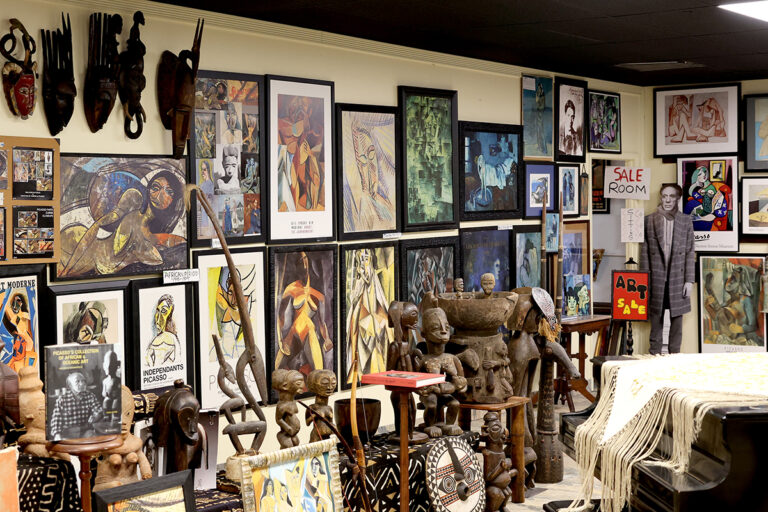
One of the more unique art-oriented establishments in the Bay area, Art Smart in Dunedin is a combined coffee house, art gallery and Picasso Museum and is owned and run by Mario Gutierrez.

It’s located in an unassuming strip center space with a large patio in front. The façade belies the huge content of creativity within. The counter on your left as you enter is a fairly typical café serving counter, a bit quirkier, with stickers, photos, artwork and statues somewhat haphazardly, yet organized, all over the place. With a quick glance to your right, the extent of the content within becomes apparent. Another world awaits. …But coffee first.

Art Smart’s coffee beans, all roasted in-house, are bought in bulk. The idea is cost, quality of product and price to the consumer. There are no Starbucks prices at Art Smart, but there is the attention to flavor and satisfaction. Buy an iced coffee and Art Smart has ice cubes made from coffee. Ensuring your coffee’s flavor and taste does not become diluted as the ice melts. That’s the attention we’re talking about. Buy a cup, or take home a bag of freshly roasted beans, ground or whole, at a price you will appreciate.

Wander with your coffee into the living space of Mario. Everything has its place. The paintings, many from local artists, are organized and displayed with professionalism. After browsing a few aisles of beautiful art, you enter the realm of Picasso. Mario is a Picasso aficionado, an expert. The bulk of Art Smarts Picasso collection, collected over many years, includes prints, posters, and statues from Picasso’s African Period. Picasso’s African Period, which lasted from 1905 to 1909, was the period when Picasso painted in a style which was strongly influenced by African sculpture, particularly traditional African masks and art of ancient Egypt, in addition to non-African influences including Iberian sculpture, and the art of Paul Cézanne and El Greco.

Over years of collecting Picasso memorabilia Mario believes he is the owner of three authentic, original pieces of Picasso art. One of which he has had the University of Tampa test the age of the paint, and it falls into the date range of Picasso’s African Period. This predates the start of the Cubist period and would make the piece the first cubist painting on record. If verified to be authentic it would have a potential auction value of one hundred million dollars. More on this in a later issue.

Beyond the Picasso Museum there are rooms somewhat hidden away in the back. There is a buyers/framing area, and there is what we will call an overflow room packed with an abundance of more art, available at affordable prices.

Exploring Art Smart, with your coffee, may take the better part of an afternoon but you will not have seen it all. A return visit may be in order. •

When the Righteous Triumph

Revealing Tampa’s Hidden Civil Rights History

A pivotal moment in Tampa’s Civil Rights history remains largely unknown, even to many locals. This chapter, absent from history books, resurfaced through a 2023 play commissioned by Stageworks Theatre. Directed by Karla Hartley, the production highlights the historic sit-ins at the F.W. Woolworth lunch counter on North Franklin and East Polk Streets and the groundbreaking Tampa Technique.

Written by Tampa playwright Mark E. Leib, When the Righteous Triumph captures the February 29, 1960 sit-ins led by Clarence Fort, President of the NAACP Youth Council, and civil rights leader Rev. A. Leon Lowry, who mobilized approximately 40 George S. Middleton and Howard W. Blake High school students to stand against segregation. For five days, they marched, staged sit-ins, faced refusal of service, and then respectfully exited, all to integrate Tampa’s ‘Whites Only’ lunch counters.

Leib discovered a book, Saloons to Steakhouse: A History of Tampa, and found a chapter titled “The Place at the Table,” which covered the sit-ins. He spoke with Fort, Rev. Lowry’s widow, and others involved in the protests. He also studied interviews with Klan members to ensure the story’s accuracy.

“As I researched it more closely, I discovered all sorts of shocking things I didn’t know even though I was born in Tampa. In 1960, an African American was not allowed in a movie theater, a bowling alley, at Lowry Park Zoo, or to sit at a public lunch counter and have a cup of coffee. They were allowed only to stand at the end of the counter, take their food, and leave. I thought this was something I didn’t know anything about, and probably most people in Tampa don’t know.”

Then-Mayor Julian Lane introduced the Tampa Technique, deploying police to protect the sit-in demonstrators and prevent violence.

Leib explains, “He didn’t want Tampa to become a byword for racial oppression. It already happened in Montgomery and Little Rock, and what those cities meant to people throughout the United States was a home for prejudice and violence. (In the Tampa Technique), the police did not arrest anybody who was not doing anything violent and made sure that the white protesters did not get close enough to the demonstrators to do them harm, and it worked very well.”

By September, Tampa’s lunch counters were integrated. Mayor Lane never won another election in Florida.

Among these courageous activists was former Florida Senator Arthenia Joyner, then a 17-year-old Middleton High School student, who stood up to racism by sitting down.

“We were asked if we would want to participate in a lunch counter sit-in, and, of course, I said yes. I wanted to go and participate because I felt that I was not being treated equally, and consequently, having experienced prejudice- that was the term in the ‘60s. It wasn’t called racism or discrimination – And so I had experienced prejudice, and I was anxious to be invited to claim dignity and respect.”

In 2025, Senator Joyner joined prominent community and political leaders Pam Iorio, Dick Greco, Bob Martinez, retired Judge E.J. Salcines, former state CFO and candidate for governor Alex Sink, former U.S. Representative Jim Davis, and Shirley Lowry (Widow of Rev. Lowry) to raise $500K to bring When the Righteous Triumph to Straz’s Jaeb Theatre.

Clay Christopher, who plays Rev. Lowry, is grateful for his time with Shirley Lowry. “The most rewarding part of this project has been the relationship I cultivated with Mrs. Lowry. She has been so accessible in helping me learn more about the Reverend and has become like another mother to me. She blessed me with many of the Reverend’s clothes. I wear Reverend Lowry’s clothes in the show, and getting to wear the man’s clothes – there’s something magical about it.”

Leib explains the importance of realizing this true story happened only three generations ago.

“These demonstrations and this bigotry that I write about was not a long time ago when if you were an African American, you didn’t dare drive through parts of Plant City. You could get lynched, and as long as Americans are not vigilant about keeping racism from resurging, it can resurge.”

Christopher added, “As my character says, at the end of the show, there’s still a lot more work to go, and unfortunately, that’s still true today, and sometimes, when peaceful people can’t get their voices out, it can cause chaos. I hope our message in the play sheds some light on what can happen and what should happen moving forward in our lives today.

“I’d like them (the audience) to learn that Tampa was once the epicenter of a civil rights movement that they’ve usually heard only took place in other cities and states, that the issues involved are of immediate interest to them and relevant. I’d like them to know that racism was alive and well only 65 years ago in Tampa. And it’s not dead yet.”

Senator Joyner is honored to see her story brought to life on stage, hoping it will shed light on the striking parallels between past and present struggles marginalized communities face.

“It is a continuous fight. I think it’s always to me, as a black woman, if you aren’t white in America, you’re going to experience racial injustice. You can never stop fighting for the right to dignity, respect, and all the Constitution says we should have – life, liberty, and the pursuit of happiness. And I want the same things everybody else has for my grandchildren, nieces, and nephews. We work twice as hard to do that other people don’t have to do, but we’re never going to stop the fight for equality and social justice in this country.

“I think the play will open their eyes as to what happened back then, and then people will be in a position to maybe educate themselves on what is happening now and how it relates to what they can do to ensure that we never go back. Nobody should be mistreated. Nobody should be trampled on. We need to work together to make America live up to its promise. The question becomes, can somebody turn the clock back and take us back to this?”

When the Righteous Triumph is a testament to the resilience and determination of those who fought for civil rights. This production serves as both an educational experience and a poignant reminder of the struggles and triumphs that shaped Tampa.

When the Righteous Triumph returns to the Jaeb Theatre for 7:30 PM performances on March 6th, 7th, and 8th and 2 PM matinee performances on March 8th and 9th with pre and post-show discussions with sit-in participants and local leaders. Over 10,000 local students are expected. For information and tickets, visit stageworkstheatre.org. •