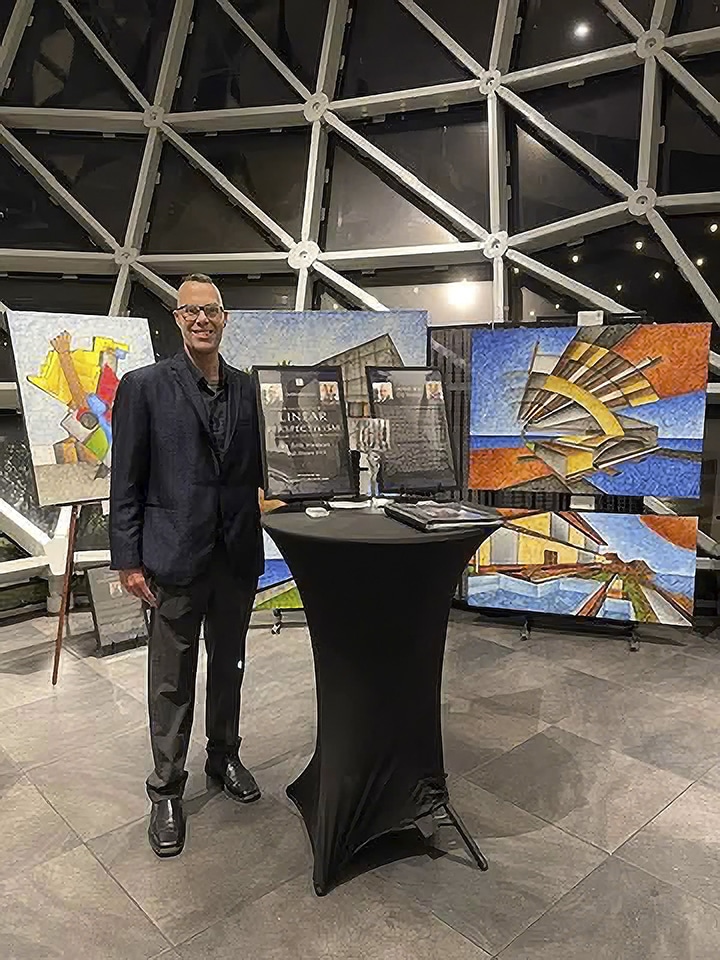


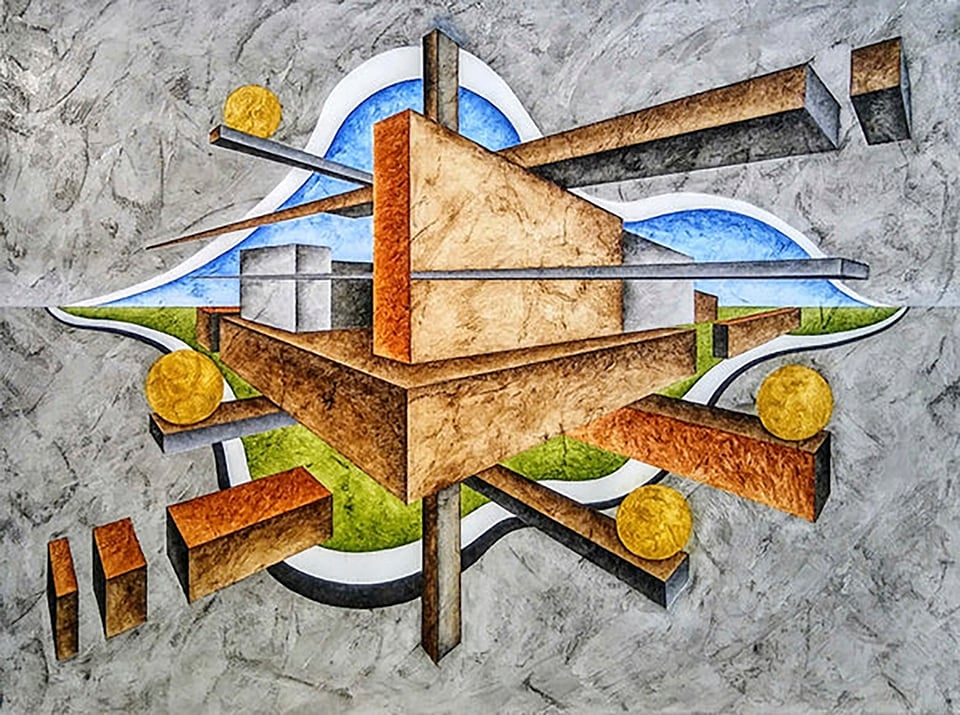
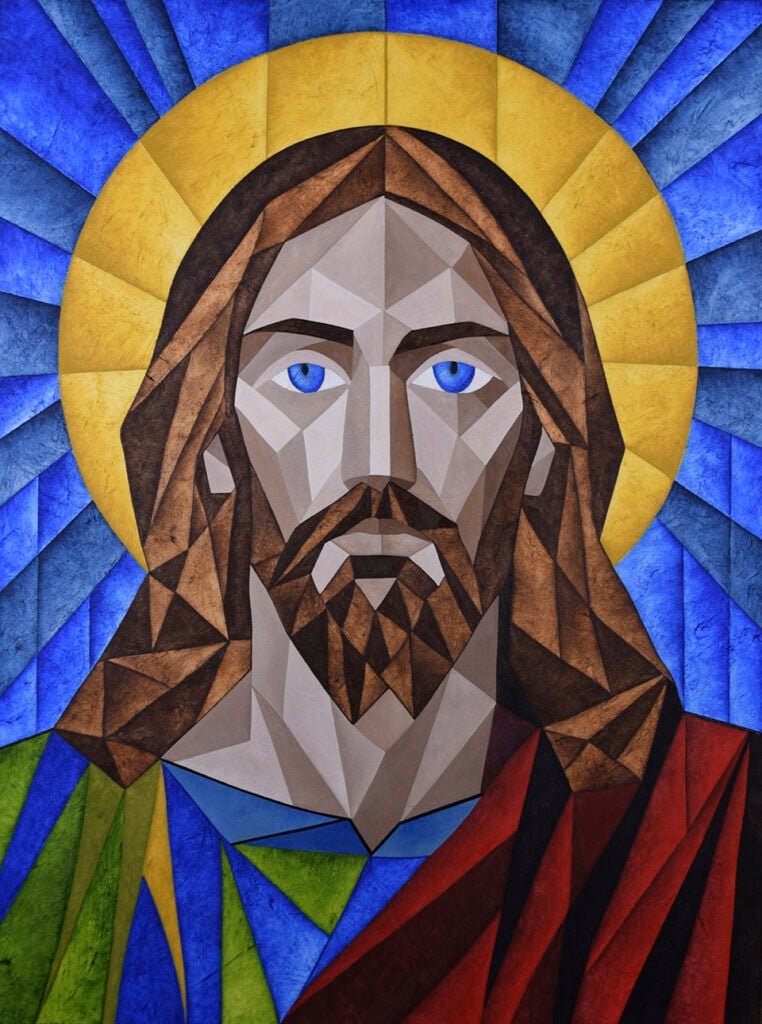
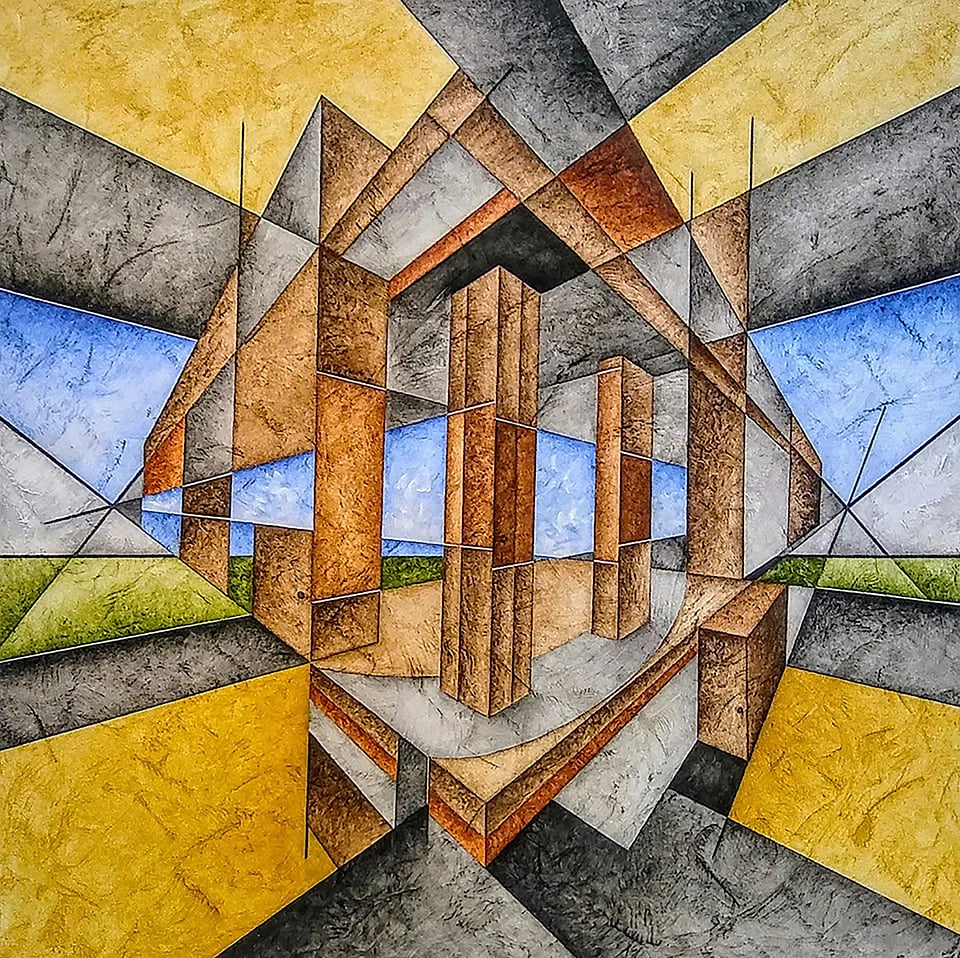
Full-time Saint Petersburg, Fl artist Erik Hesson has, over many years, developed and refined a personal artistic style he calls “Linear Perspectivism.” His abstract, geometric approach merges shape and color into a cohesive visual balance—an ordered structure.
When did you first realize that art was more than a passion—that it was going to be your life’s work?
I’d like to think that it was from the very beginning of my artistic journey, which was at the age of 22 in the year 2002. I live by a lifestyle philosophy called Kaizen, which in its essence is a commitment to a process of perpetual improvement over the course of one’s lifetime. And I try to apply that to all areas of my life, especially artistically. And although I started my artistic journey with literally no experience and no artistic skill of any kind, I was fully committed to improving my skills and honing my artistic vision over the course of my lifetime. Prior to that, my only artistic experience was in a cognitive dream that I had literally the night before I went and bought art supplies for the first time and started painting. In that dream, I remember coming home to a warehouse-type dwelling and looking up at the walls to see numerous paintings that I had an innate feeling were my own originals that I had created. And in that same dream, I also had an easel setup in the corner of the room with a work-in-progress, and I went over to it and actually started painting in my dream for what seemed like a few hours. Inspired by my vivid memories of that dream, the feeling I had of finding my life’s purpose, and the artistic vision of the paintings that were hanging on the walls in my apartment from that dream, I decided to start my artistic journey the next day and was fully committed to improving over time and making it my life’s work.
Because you’re self-taught, what challenges or freedoms came with developing your own creative path outside of formal training?
As you can imagine, for someone with no formal training, there were many challenges along the way and also infinite freedoms that were both a blessing as well as extremely tough to overcome and figure out at times. The first challenge was figuring out a medium that worked for me, and figuring out how to apply that medium to the canvas in an interesting way. At first, I experimented with acrylic paint and was applying it in a very remedial way to the canvas. And then I found that oil paint actually suited me better and I eventually discovered a unique way to use it. Overcoming this challenge led me to the discovery of my unique paint application method which produces my signature texture and my easily identifiable brushstroke character. Another great challenge was figuring out what art style best expressed my artistic vision. I originally experimented with numerous art styles, such as abstract expressionism and impressionism, while all the while desiring to find my own unique expressive style and to contribute something unique to the art world. Eventually leading me to the development of my signature art style Linear Perspectivism in 2017.
How did your journey as a self-taught artist lead you to develop what you now call “Linear Perspectivism”?
After about 15 years of searching for my own unique artistic voice and style, I kinda just had a lightbulb moment and came up with the idea to create a style that took a basic underlying design element, linear perspective, and make it a featured and central component to the aesthetic/composition of the piece.
In your words, “What Cubism did to the cube, Linear Perspectivism does to linear perspective.” Can you unpack what that means for viewers encountering your work for the first time?
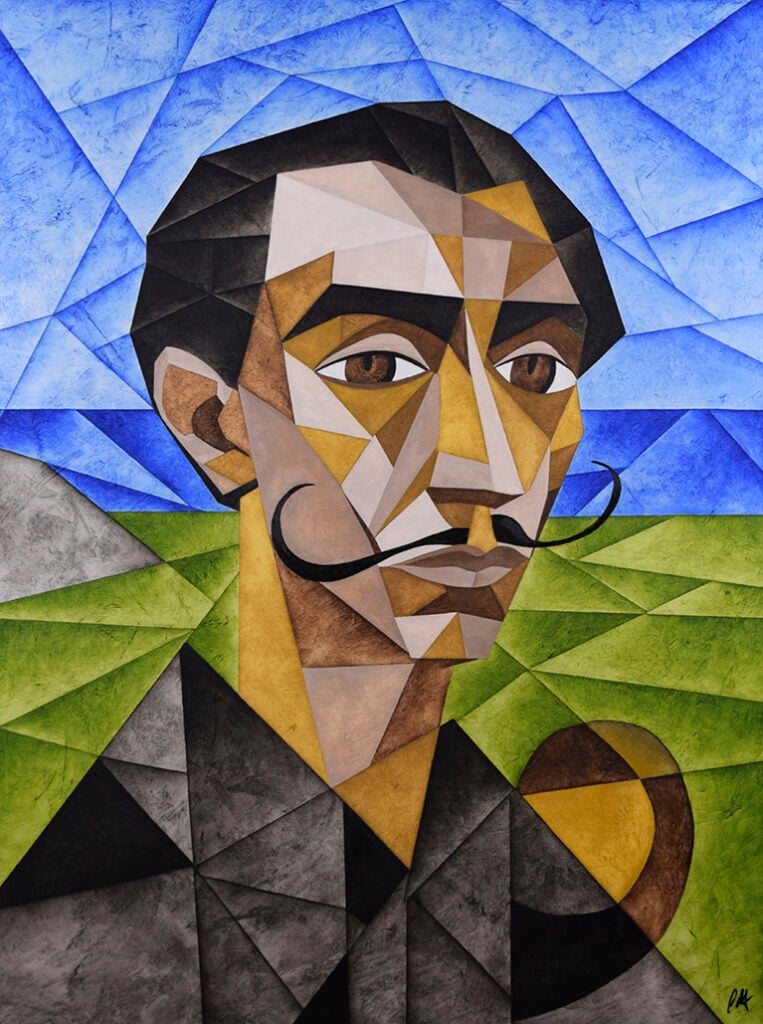
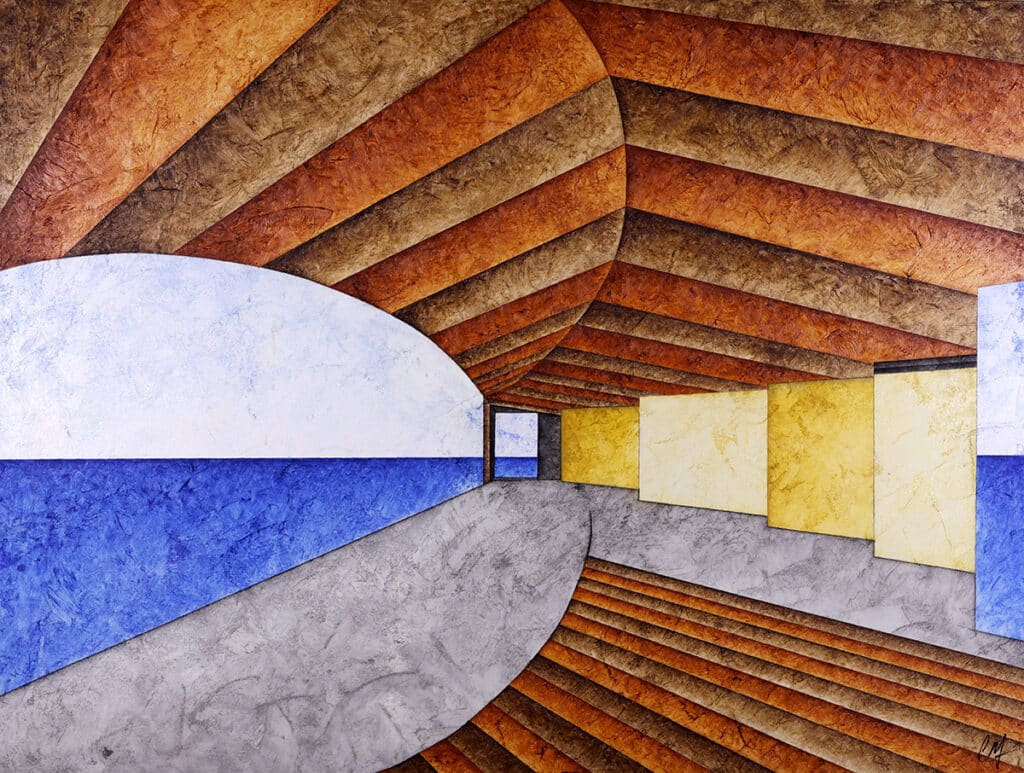
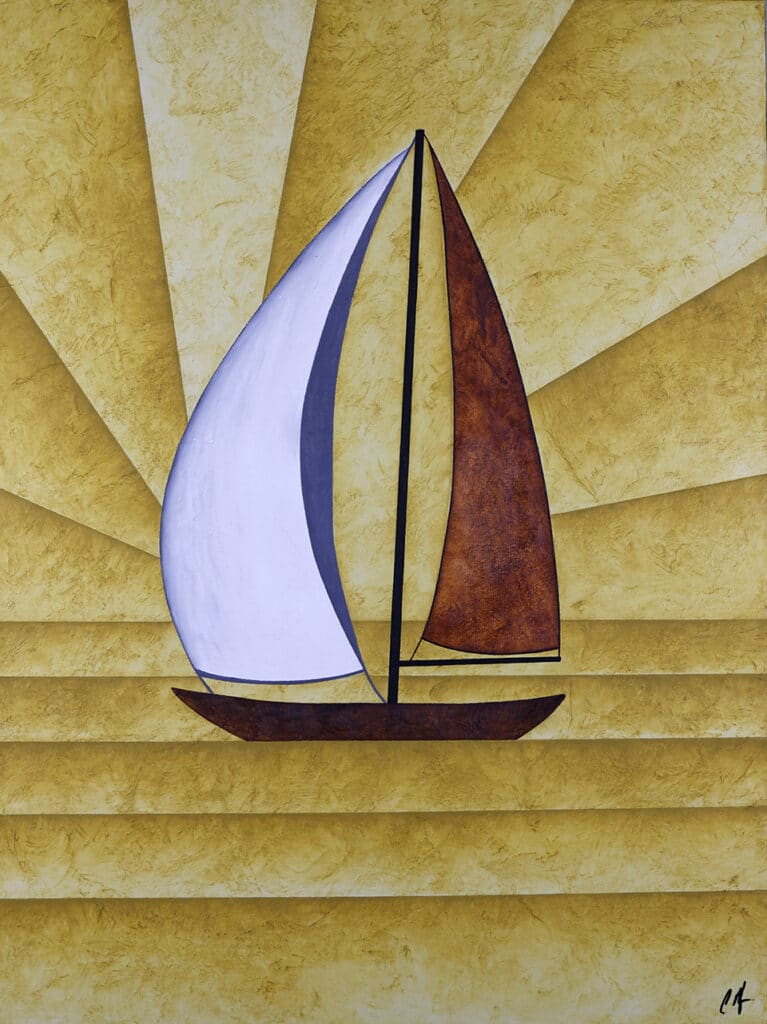
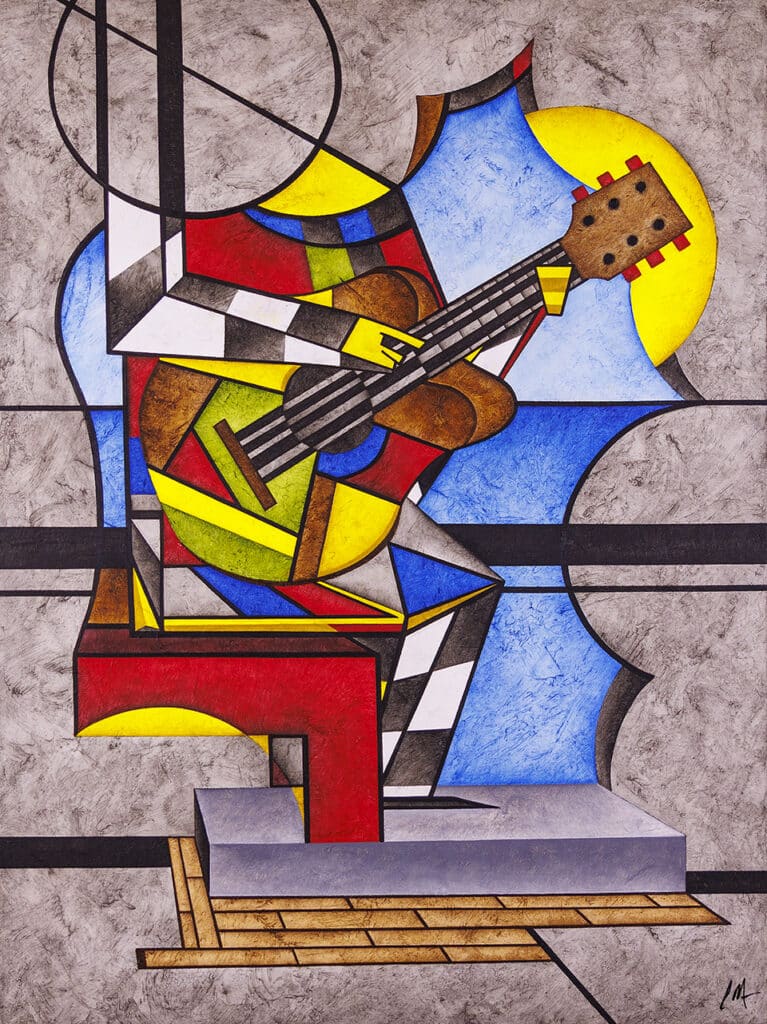
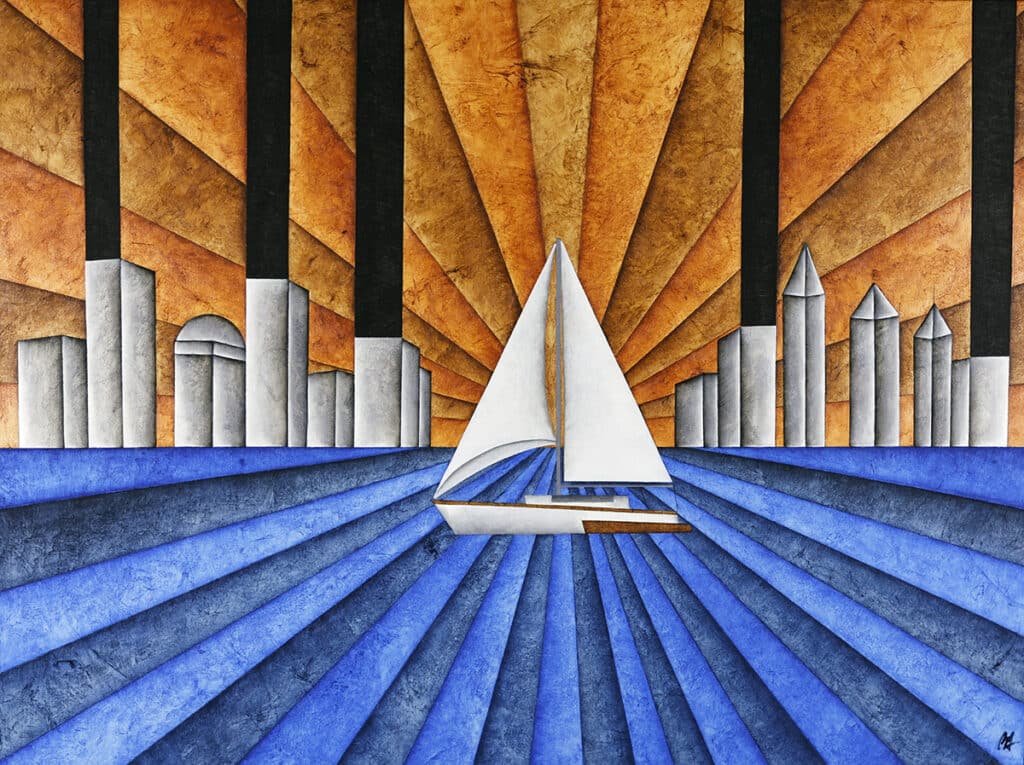
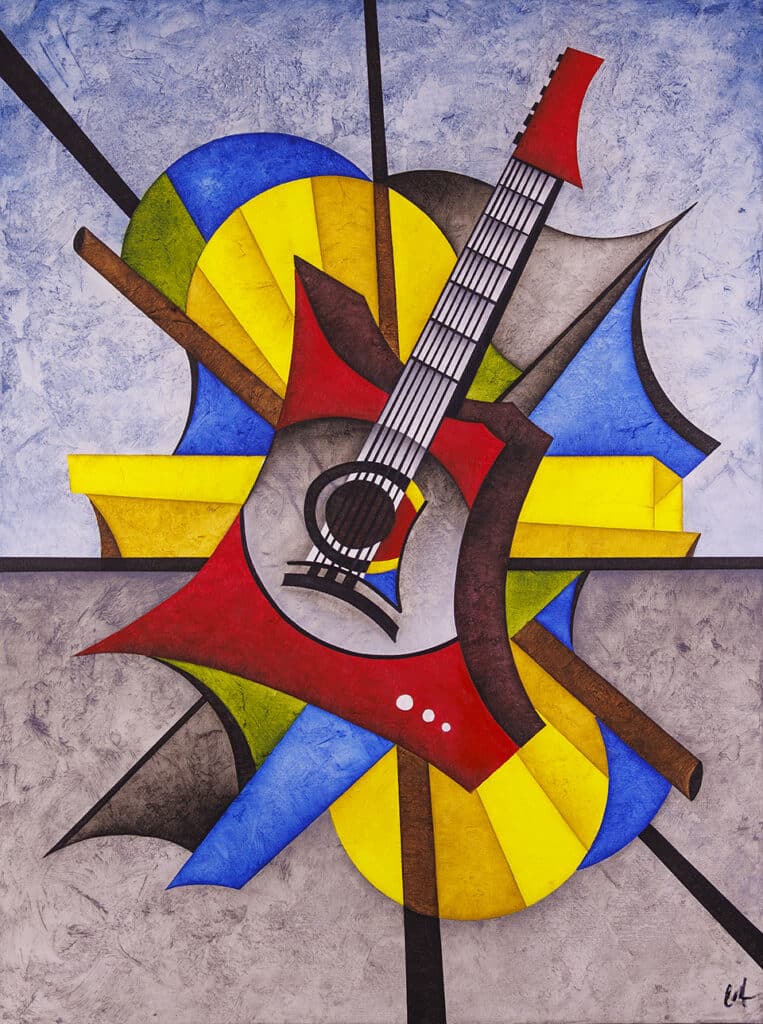
Sure. With Cubism, Picasso took a basic fundamental component, in this case the cube or the 3d space that a cube creates, and decided to make it a central component of the construction of the composition and a featured element of the overall aesthetic of the artwork. Linear Perspectivism does something similar with the basic fundamental design element of linear perspective. Where the two styles differ fundamentally is in the fact that Cubism is a rejection of traditional linear perspective from a single vantage point, and Linear Perspectivism utilizes and features traditional linear perspective from a single vantage point as a main component of the overall aesthetic and in the construction of the composition of each piece.
What inspired you to elevate linear perspective—usually a background structure—into the dominant visual language of your compositions?
To be honest, it was just one of those lightbulb moments/ideas that came to me deep in the midst of a journey trying to figure out a unique way to express my artistic vision for many years prior. I’ve always had a deep desire to contribute something truly unique to the art world and to art history, and this is what I’ve come up with.
Growing up in Valrico and now working in St. Pete, how has your environment shaped your artistic identity?
Well, I’ve lived in St. Pete since 2014 and I created Linear Perspectivism in 2017. So, I’m not exactly sure how St Petersburg specifically contributed to the creation of Linear Perspectivism, but I truly believe that I would not have reached that point of artistic discovery in any other environment. It is very inspiring to live here in St Pete and be in such a rich cultural environment amongst so many talented creators and passionate patrons of the arts. I absolutely love the collective energy here and I plan on living and working here for the rest of my life.
Your work blends geometric abstraction, vibrant color, and classical proportion. How do you balance intuition with structure when creating a piece?
Every piece and subject matter is a slightly different decision-making process, but I always try to imagine my chosen subject matter within the parameters, characteristics, and aesthetics of my art style Linear Perspectivism. Which are: basic 3d geometric representations of persons, places, and things; from a single vantage point, with bold colors, and using my unique paint application method and texture. Sometimes, I create a composition entirely in my head and then sketch it on canvas and then paint it. Sometimes, I just think of a starting point for a composition and then figure it out in-the-moment as I’m sketching it on the canvas. Sometimes, I go to a desired location around town and take a picture of it myself from a vantage point I like and then create a Linear Perspectivism version of it. And a few times, I’ve found an image via internet search that I wanted to recreate in my Linear Perspectivism style, so then I do that. I always just use my artistic eye and intuition to see what looks right and feels right throughout the process. I just try to balance both as best I can for each moment and hopefully the result turns out well.
You work in both oil painting and digital media/AI—what does each medium allow you to express differently?
I experimented with creating digital artworks in the past using a drawing tablet and Adobe Illustrator a few years ago, and now at this point, I’ve decided to focus solely on creating oil paintings on canvas and I only use digital art programs for creating random graphic designs and random sketches/ideas for oil painting compositions once in awhile.
For real artists, AI can be a great tool for creating ideas and accomplishing various tasks very easily. I personally use it quite a bit as a timesaver and for various business-related tasks that would normally require a team of people to accomplish. Once in awhile, I also use it for creating composition ideas or inspirations for paintings if I’m ever stuck or struggling to come up with a specific idea/composition for my next painting.
You’re a recurring presence at the Dalí Museum patio exhibits. How has this affected you and your work? And how has engaging directly with the public influenced your evolution as an artist?
My collective experiences at the Dali Museum and interacting with a wide range of art lovers has had a profound effect on me personally and professionally. It’s very rewarding to share my art with people from all around the world and for it to be well-received by a vast majority of them. And I do also sometimes receive constructive criticism, which I appreciate as well, and take into account for future reference. And for an introvert like myself, it’s great to meet so many new people in general and hear their thoughts and comments. And it’s also very humbling to meet some of the great masters of art and industry that I’ve met while exhibiting my work there. I’ve learned that art is a universal language and I want the language I communicate to be a positive one and one that is filled with love and respect.
Tell us about the vision behind your community initiative “I AM ST PETE” and how it ties into your artistic practice.
The idea behind my community initiative I AM ST PETE is to highlight and celebrate the uniqueness and diversity of all the wonderful people who make St Pete such a great place to live and work.
When someone stands in front of work, what do you hope they feel or understand about your approach to perspective and abstraction?
First off, I hope they like what they’re looking at. Then, I hope they can feel the positive energy that when into creating it and that I’m hoping to convey to the viewer. And then, I hope they see it as something new that they’ve never seen before and that they innately enjoy looking at. And I would love for my work to inspire others in any way. •